Hair, odor, and the underarm
Does armpit hair make you smell? The less annoying answer.
A question that gets asked a lot and answered badly. The short version: hair itself isn't dirty, but hair does change underarm chemistry in measurable ways. The longer version is more useful than either side of the argument usually allows.
Odor lives on skin, not on hair
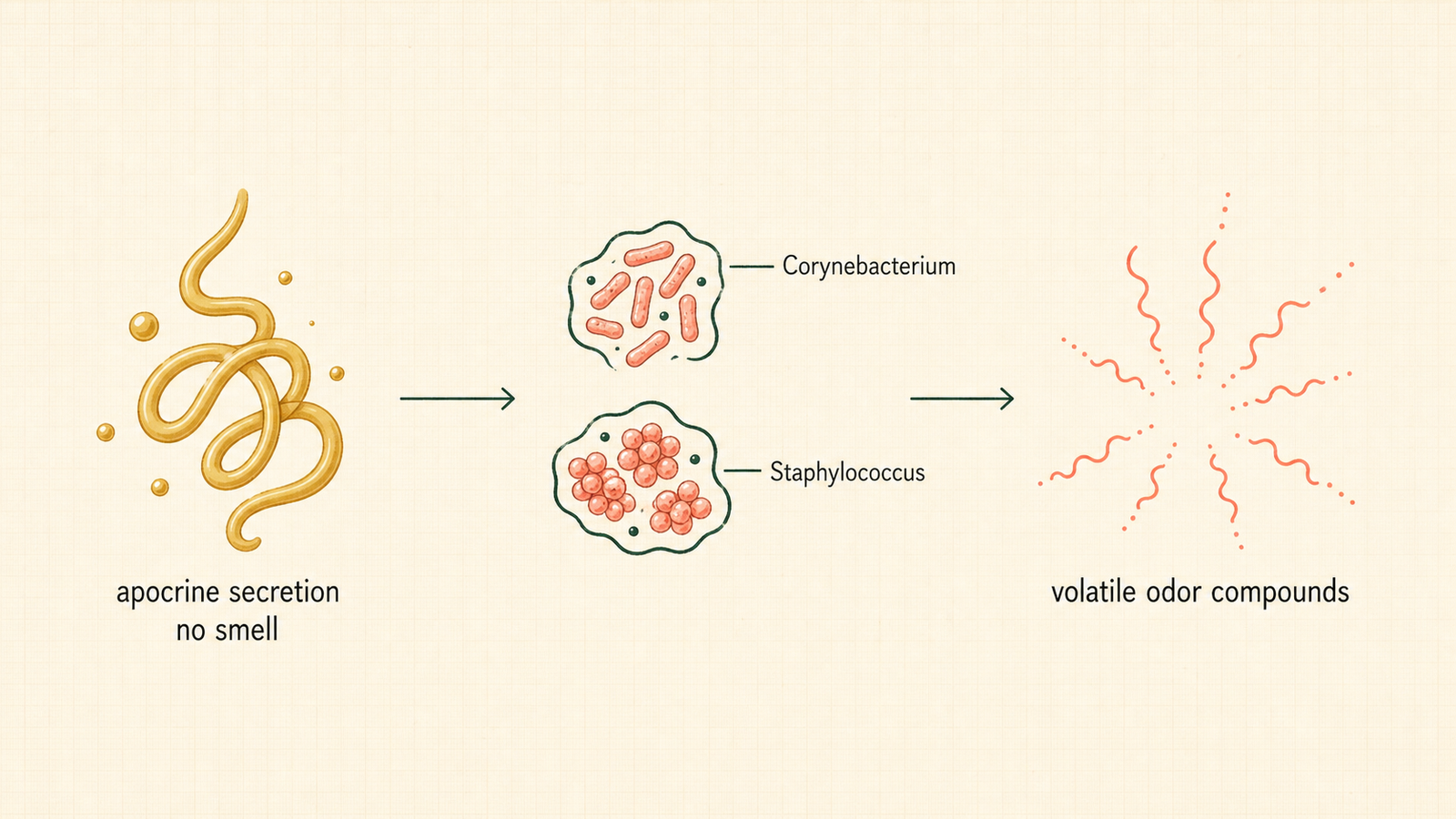
Apocrine glands release odorless secretions. Resident bacteria (mainly Corynebacterium and Staphylococcus) turn those secretions into the smell.4
Shaving lowered odor scores in the one good trial
Lanzalaco and colleagues, 2016: blade shaving plus soap dropped underarm odor scores by 57% on Day 1 versus soap alone, versus 27% for clipping.1
Washing matters more than the hair decision
Hair-or-no-hair changes the size of the effect, but the daily underarm wash does most of the work either way.
The hair isn't the smell
If you stop somebody on the street and ask why armpits smell, the most common answer is "the hair." It's a clean, intuitive theory. It's also wrong in the most important sense, and right in a smaller one that's worth understanding.
Underarm odor is a chemistry handoff. Apocrine glands, which sit under the skin and concentrate in the underarm, release secretions that on their own are essentially odorless. Sitting on the skin surface is a resident bacterial community, mainly Corynebacterium and Staphylococcus with some Propionibacterium, that together accounts for roughly 96% of the underarm microbiome.4 Those bacteria carry enzymes that cleave the apocrine precursors into the volatile compounds the nose actually reads as body odor: short-chain carboxylic acids, sulfur compounds, and a few odorant steroids.4
None of that requires hair. Pre-pubescent children have axillary glands but minimal odor; what changes at puberty is gland activity and skin chemistry, not hair density alone. People with the ABCC11 gene variant common across much of East Asia have functioning apocrine glands and varying hair, but produce little of the precursor compound and so produce little odor. The hair, in other words, is not where the chemistry happens.
What hair actually changes
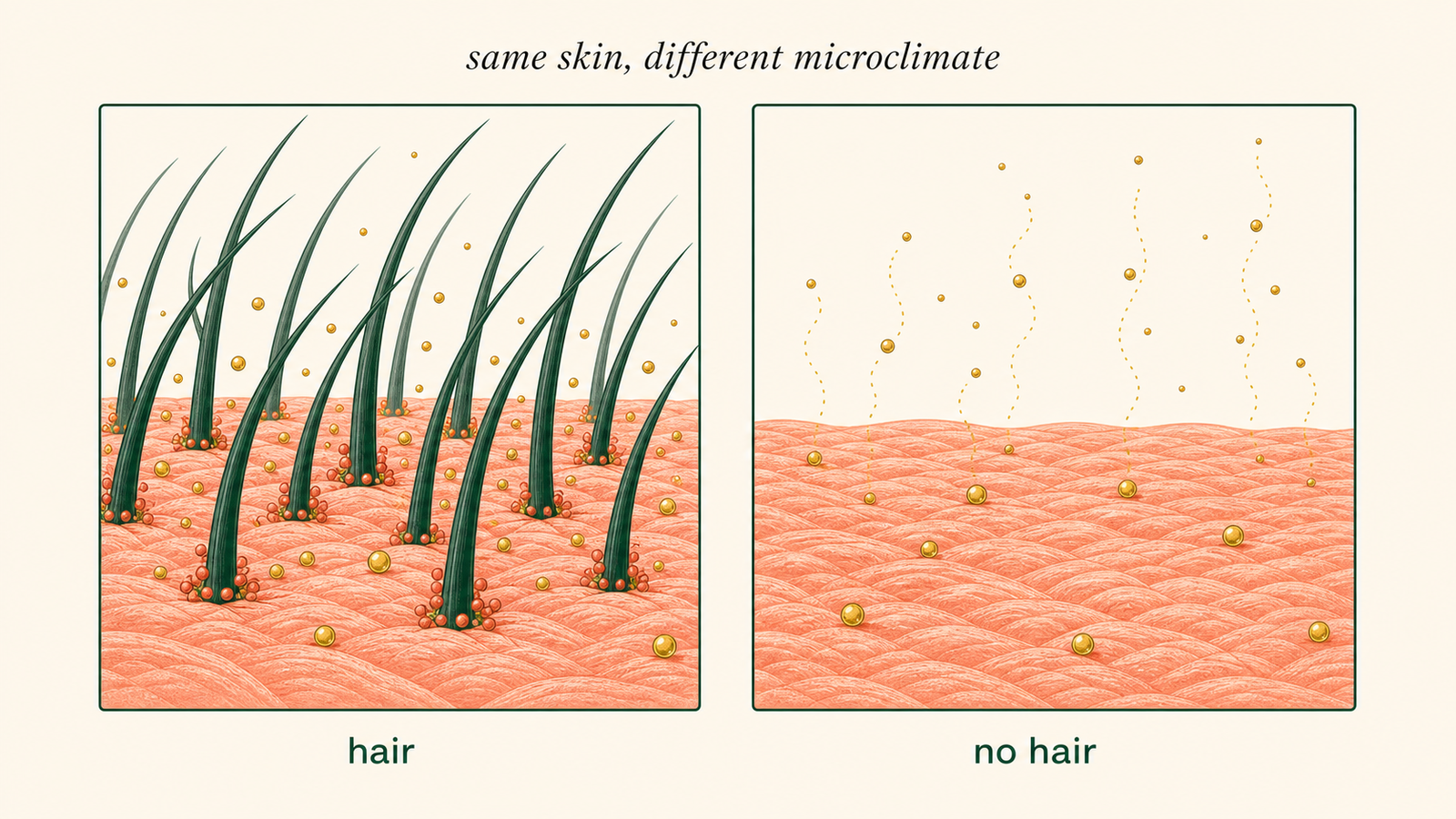
Hair shafts are not chemically reactive in a way that produces odor on their own. What they do is change the underarm's small environment. A hair-bearing underarm holds moisture longer after sweating and after washing. It carries more sebum and residue along each shaft. It gives the resident microbes more surface area and a damper, warmer pocket to live in. And it changes how soap, water, and product physically contact the skin during a shower.
That last point is the one the published evidence is clearest on. Lanzalaco and colleagues' 2016 study in the Journal of Cosmetic Dermatology is the rare actual trial of this question. They put 30 men through a split-body protocol: one armpit shaved, one waxed, one clipped with scissors, one left untreated, with daily soap washing on all four. Trained assessors scored odor on an 11-point scale across three days.1, 2
The result: blade shaving with soap washing produced a 57% reduction in odor score on Day 1 versus soap alone. Waxing produced 75%. Scissor clipping produced 27%, barely different from soap by itself. The mechanism the authors proposed wasn't "hair smells." It was that retained secretions and debris on the hair shaft act as a medium for microbial growth, and that blade shaving and waxing remove hair along with dead skin and sebum, letting soap reach surfaces that would otherwise stay coated.2
That's a real finding and worth reporting honestly. It also has limits. The trial was 30 men. Effects faded across three days. And one practical detail the authors flagged but didn't dwell on: waxing produced the strongest immediate result but the most discomfort, and the comparison was always against soap washing, not against doing nothing.
The hygiene part is the same job
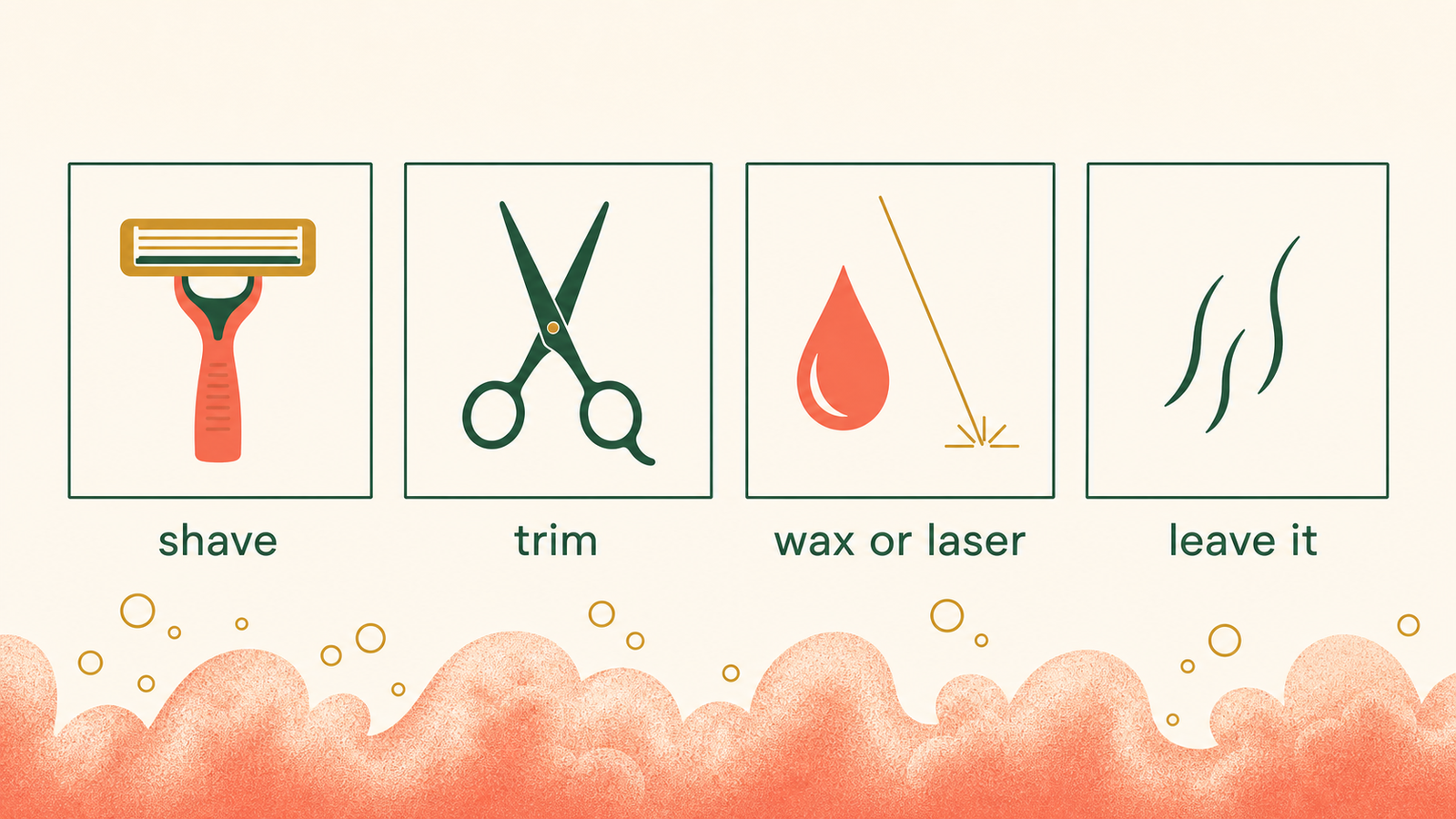
The reader of this article is probably in one of three rooms: shaving and wondering if they're shaving for the wrong reason, not shaving and tired of being told they smell, or considering laser or waxing and curious about hygiene implications. The research has a useful thing to say to all three.
To the first room: yes, blade shaving does measurably reduce odor scores, and the mechanism is plausible — it gives soap a cleaner path to skin and removes the sebum-laden surface layer that bacteria like. That's a real effect, not a beauty-industry invention. It also lasts only a few days before hair returns and the effect levels back out. Daily washing remains the dominant variable. Shaving doesn't replace it.
To the second room: hair on its own is not making you smell. The smell is on skin, not strand. Washing skin works the same whether the hair is there or not. The Evans et al. 2020 study in the International Journal of Cosmetic Science tracked what happens to underarm skin after shaving, plucking, and waxing in 64 women, and found that all three caused short-term irritation, with shaving showing less redness but more dryness and the inflammatory markers settling within 48 hours.3 Hair removal is a skin event in its own right. Skipping it is an entirely reasonable thing to do.
To the third room: laser or waxing produces the cleanest version of the soap-reaches-skin effect, since the hair doesn't come back to interrupt it. That doesn't make the underarm self-cleaning. The bacterial community moves back in within hours of any shower, and the apocrine glands keep secreting whether there's hair above them or not. The wash is still the wash, just with less surface to work around. Worth saying out loud: nothing in the Lanzalaco data argues people should change what they're doing with their hair. It argues that the daily underarm wash is doing slightly more work than people assume, and slightly less than the marketing of any one method tends to promise.
Where a cleanser fits
This is the part where, in a different sort of article, we would tell you that hair doesn't matter as long as you do the right ritual with the right product. We won't, because that's selling. What we will say is plainer.
GoodSweat is a foaming rinse-off underarm cleanser, used in the shower, finished before the shirt goes on. It's a cosmetic — it deodorizes, it freshens, it reduces odor on skin. The named ingredient is Octenidine HCl, an antimicrobial molecule with decades of European clinical use, here scoped to its job in the formula. The foam reaches skin around or under hair on the way to the drain. It doesn't leave a layer behind. It's friendly to whichever hair state you're in — shaved this morning, trimmed last weekend, lasered last year, never touched. The wash is the wash either way. We just made one for the underarm specifically.
And then the bathroom is just the bathroom. You get dressed, the day starts, the question you asked at the top of this article stops being interesting. Which is the right outcome for a question about your own armpit.
Sources
- Lanzalaco A, Vanoosthuyze K, Stark C, Swaile D, Rocchetta H, Spruell R. "A comparative clinical study of different hair removal procedures and their impact on axillary odor reduction in men." Journal of Cosmetic Dermatology, 2016. PubMed record for the split-body trial comparing shaving, waxing, clipping, and untreated underarms in 30 men, with trained-assessor odor scoring across three days.
- Lanzalaco A et al. "A comparative clinical study of different hair removal procedures and their impact on axillary odor reduction in men." PMC full text, J Cosmet Dermatol 2016. Full-text record used for the 57% (shaving) / 75% (waxing) / 27% (clipping) Day 1 odor-score reductions and the authors' proposed mechanism about hair-shaft sebum and dead skin.
- Evans RL, Bates S, Marriott RE, Arnold DS. "The impact of different hair-removal behaviours on the biophysical and biochemical characteristics of female axillary skin." International Journal of Cosmetic Science, 2020;42(5):436-443. Sixty-four-woman study comparing shaving, plucking, and waxing on erythema, dryness, barrier function, and inflammatory markers.
- Troccaz M, Gaia N, Beccucci S, Schrenzel J, Cayeux I, Starkenmann C, Lazarevic V. "Mapping axillary microbiota responsible for body odours using a culture-independent approach." Microbiome, 2015;3:3. 16S sequencing study used for the Corynebacterium / Staphylococcus / Propionibacterium 96% figure and the apocrine-to-volatile-compound mechanism.