Hair, odor, and underarm care
Armpit hair and odor, explained
Hair is normal. Odor starts on skin. Hair can still change the conditions around that skin: moisture, residue, surface area, and how easily you rinse clean.
Odor starts on skin
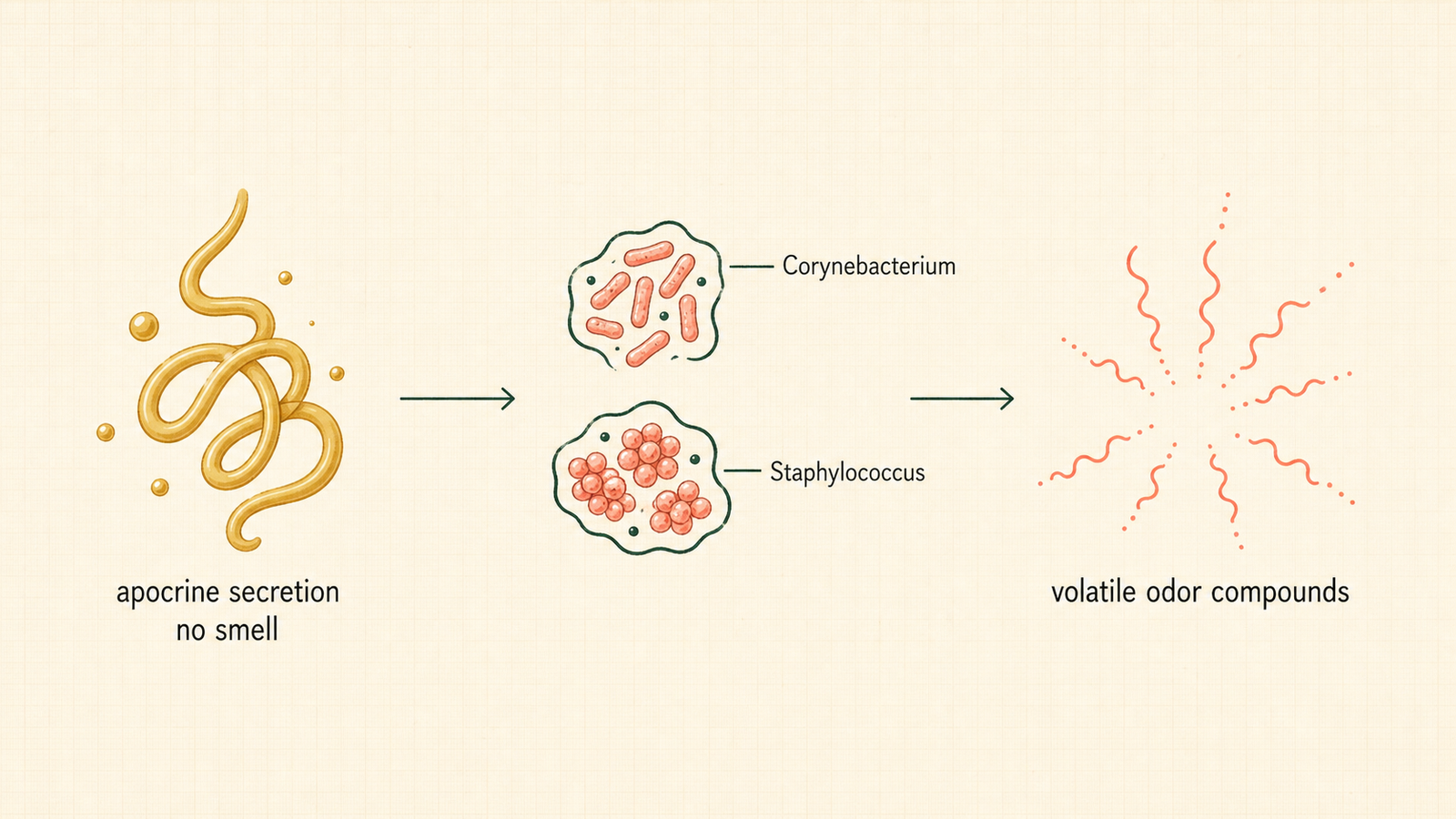
Apocrine glands release odorless secretions. Skin bacteria, especially Corynebacterium and Staphylococcus, can turn them into odor compounds.4
Hair changes the setting
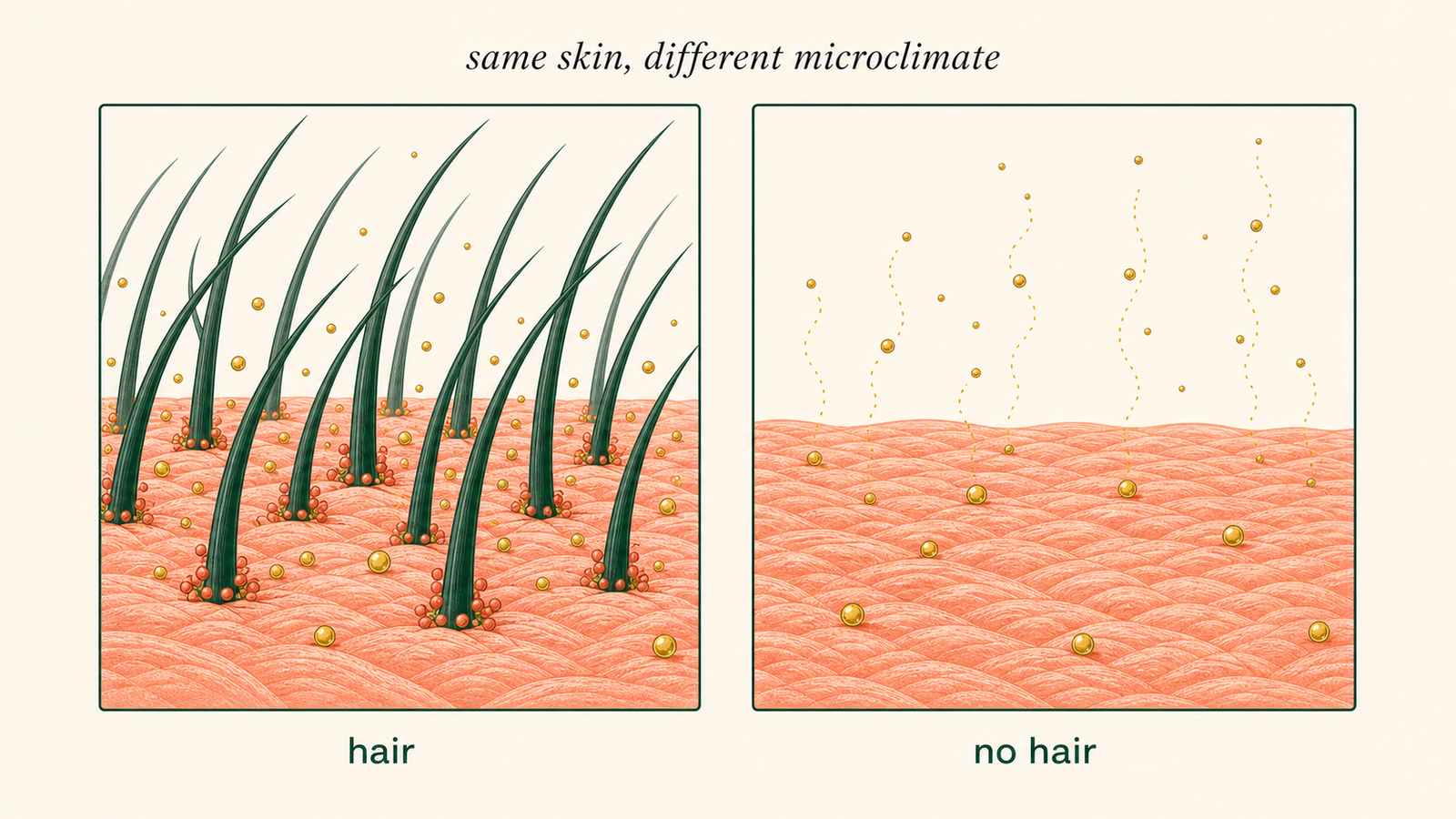
Hair can hold moisture, sebum, and residue. It can also change how directly soap, water, and a shower deodorant reach the skin.
Hair removal is optional
In one small study, shaving plus soap lowered odor scores more than soap alone. Daily washing still did the steady work.1
Odor starts on skin
Hair gets blamed because it is easy to see. The chemistry is harder to see. Underarm odor begins when odorless gland secretions meet bacteria living on the skin.
Apocrine glands sit under the skin and are concentrated in the underarm. Their secretions are mostly odorless on their own. On the skin surface, a resident bacterial community, mainly Corynebacterium and Staphylococcus with some Propionibacterium, makes up much of the underarm microbiome.4 Those bacteria carry enzymes that can turn apocrine precursors into the volatile compounds people notice as body odor: short-chain carboxylic acids, sulfur compounds, and some odorant steroids.4
Hair can be present or absent. The basic odor pathway still needs gland secretions, skin oils, microbes, warmth, and time. Removing hair may change that environment, but the underarm still needs washing.
What hair changes
Hair shafts do not make odor on their own. They change the small environment around the underarm. Hair can hold moisture after sweating or washing. It can carry sebum and product residue along the shaft. It can give skin microbes more surface area and a warmer, damper place to sit. It can also change how soap, water, and a shower deodorant contact the skin during a shower.
The clearest published evidence is a 2016 Journal of Cosmetic Dermatology study by Lanzalaco and colleagues. The researchers compared shaving, waxing, clipping, and no hair removal in 30 men, with daily soap washing and trained odor scoring across three days.1, 2
On Day 1, blade shaving plus soap lowered odor scores by 57% compared with soap alone. Waxing lowered scores by 75%. Scissor clipping lowered scores by 27%, closer to soap by itself. The authors' explanation was practical: hair can retain secretions, dead skin, and sebum, while shaving or waxing removes some of that material and gives soap a clearer path to skin.2
That finding is useful, with limits. The trial was small, included men only, and followed effects for a short window. Waxing had the strongest immediate result and the most discomfort. The study supports a modest hygiene point, not a mandate about what anyone should do with their hair.
Keep the hair choice separate from the wash
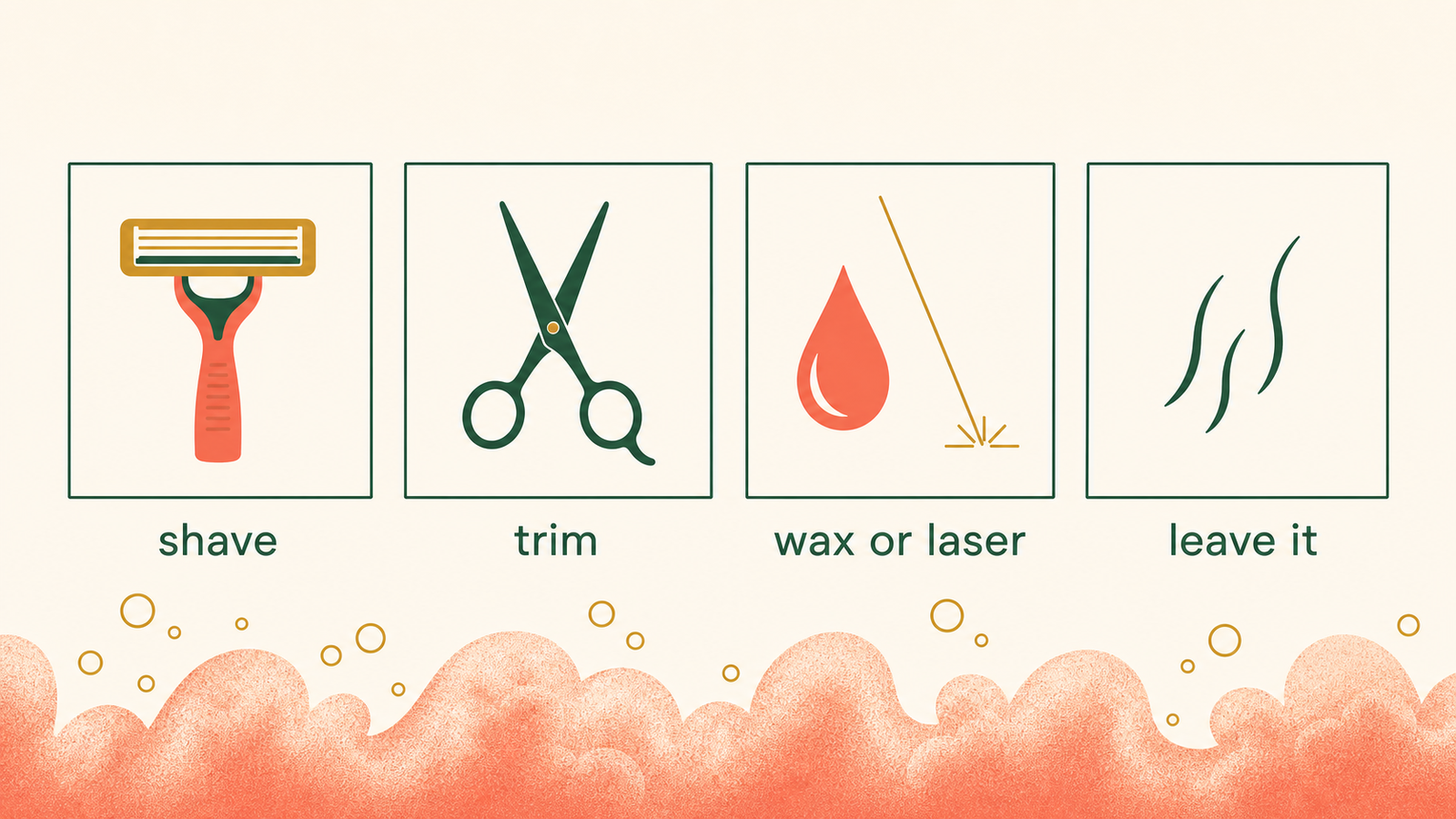
The useful conclusion is simple: hair choice is personal, and underarm care still has to reach skin.
If you shave, there is evidence that it can reduce odor scores for a short time. The likely reason is physical. Soap reaches skin more directly, and some sebum, residue, and dead skin leave with the hair. Washing still matters. Shaving only changes the surface you are washing.
If you keep the hair, that is still a clean choice. Odor chemistry happens on skin. Washing skin works whether hair is there or not. A 2020 International Journal of Cosmetic Science study followed underarm skin after shaving, plucking, and waxing in 64 women. All three caused short-term irritation, with shaving showing less redness but more dryness, and inflammatory markers settling within 48 hours.3 Hair removal is a skin event. Skipping it is reasonable.
If you wax, laser, trim, or leave the hair alone, the base job stays the same: cleanse the underarm skin, remove residue, rinse clean, and let the day move on. The research supports a better shower routine, not one hair choice.
Where a shower deodorant fits
GoodSweat is a rinse-off shower deodorant used in the shower. Squeeze on, massage in, rinse clean. It is made for odor on skin, then it goes down the drain before the shirt goes on.
The cream can be used around underarm hair, on shaved skin, or on trimmed skin. It gives underarm care a clear place in the shower routine, so you can get dressed without the sticky swipe.
Hair matters a little. Skin matters more. Washing well matters every day.
Sources
- Lanzalaco A, Vanoosthuyze K, Stark C, Swaile D, Rocchetta H, Spruell R. "A comparative clinical study of different hair removal procedures and their impact on axillary odor reduction in men." Journal of Cosmetic Dermatology, 2016. PubMed record for the split-body trial comparing shaving, waxing, clipping, and untreated underarms in 30 men, with trained-assessor odor scoring across three days.
- Lanzalaco A et al. "A comparative clinical study of different hair removal procedures and their impact on axillary odor reduction in men." PMC full text, J Cosmet Dermatol 2016. Full-text record used for the 57% (shaving) / 75% (waxing) / 27% (clipping) Day 1 odor-score reductions and the authors' proposed mechanism about hair-shaft sebum and dead skin.
- Evans RL, Bates S, Marriott RE, Arnold DS. "The impact of different hair-removal behaviours on the biophysical and biochemical characteristics of female axillary skin." International Journal of Cosmetic Science, 2020;42(5):436-443. Sixty-four-woman study comparing shaving, plucking, and waxing on erythema, dryness, barrier function, and inflammatory markers.
- Troccaz M, Gaia N, Beccucci S, Schrenzel J, Cayeux I, Starkenmann C, Lazarevic V. "Mapping axillary microbiota responsible for body odours using a culture-independent approach." Microbiome, 2015;3:3. 16S sequencing study used for the Corynebacterium / Staphylococcus / Propionibacterium 96% figure and the apocrine-to-volatile-compound mechanism.