Odor chemistry guide
How sweat becomes underarm odor
Sweat is mostly a cooling fluid. Underarm odor often arrives later, when natural secretions meet skin microbes, warmth, fabric, and time.
Sweat cools
The body uses sweating for cooling, especially through eccrine glands across much of the skin.
Odor builds later
Many underarm odor notes come from low-odor secretions that change on the skin over time.
The short version skips a lot
"Sweat plus bacteria equals stink" is memorable, but it skips the precursors, the gland mix, and the time involved.
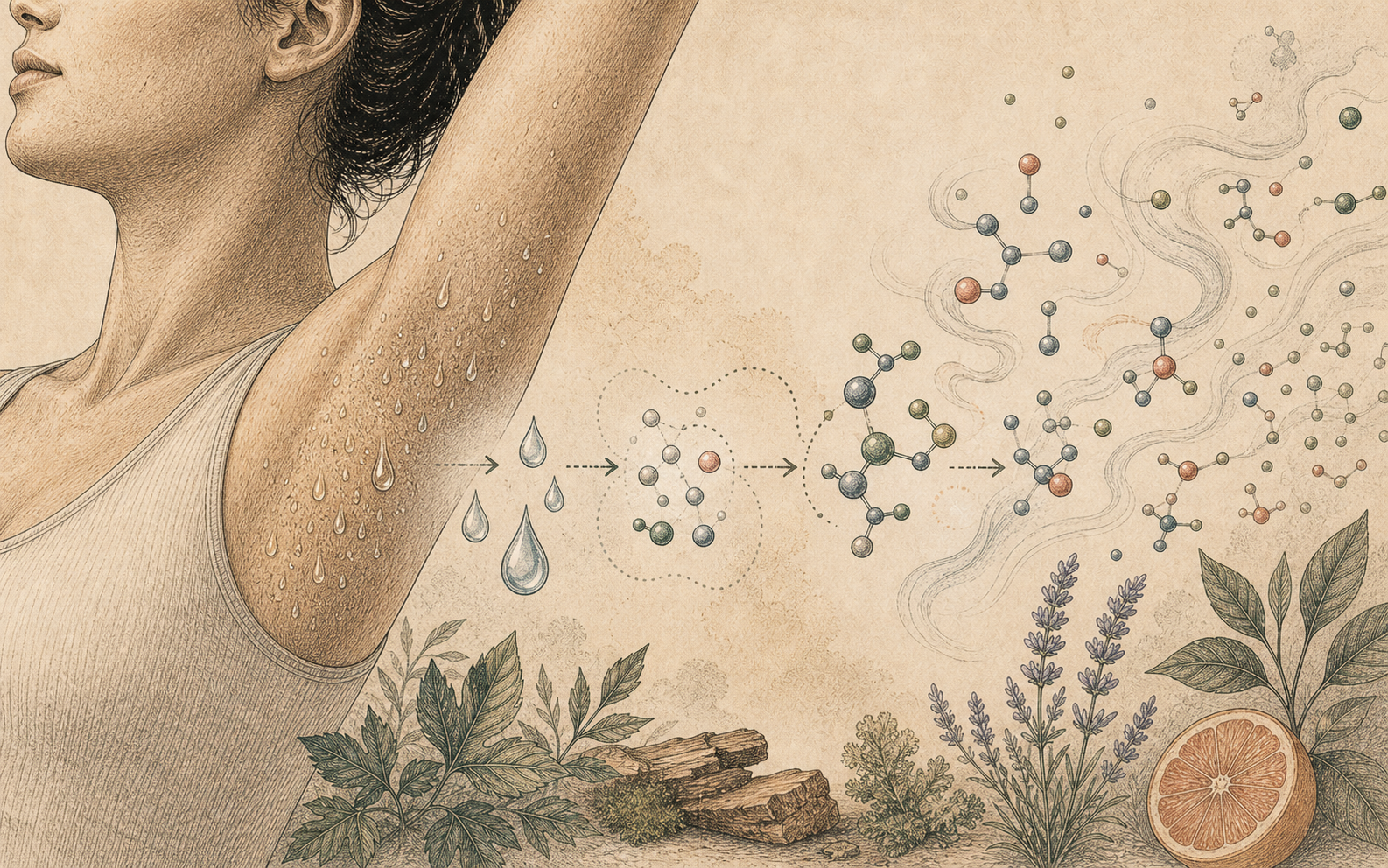
Sweat gets blamed for the whole story
The phrase "sweaty smell" makes it sound as if sweat leaves the body already smelling bad. Sweat is a normal body fluid with a useful job, especially when the body needs to cool itself.1, 2
The smell people worry about under the arm is usually not the first thing that leaves the gland. It is what happens after underarm secretions meet the skin surface, local microbes, warmth, fabric, and time.
That distinction matters. Odor is the enemy, not sweat. Sweat can keep doing its cooling job while the shower routine focuses on what builds up in the underarm.
The underarm has its own chemistry
You have probably heard the simple line: odor appears once bacteria get involved. Useful, but tidy. The underarm runs on different gland pathways, different secretions, and a different microbial mix than the open skin on your forearm.
Eccrine sweat helps cool the body. Apocrine glands, found in hair-bearing areas such as the underarm, add different secretions to the mix.1, 2 That mix sits in a warm fold of skin, often under fabric, with limited airflow.
James AG and colleagues, writing in FEMS Microbiology Ecology in 2013, and Minhas, Bawdon, Herman and colleagues, writing in eLife in 2018, describe odor precursors that are not especially smelly at first, and only become volatile odor molecules after microbial transformation.3, 4
That is why two people can both sweat and only one shirt announces it. It is also why the same person can smell different after a run, a stressful meeting, a polyester top, or a long commute.
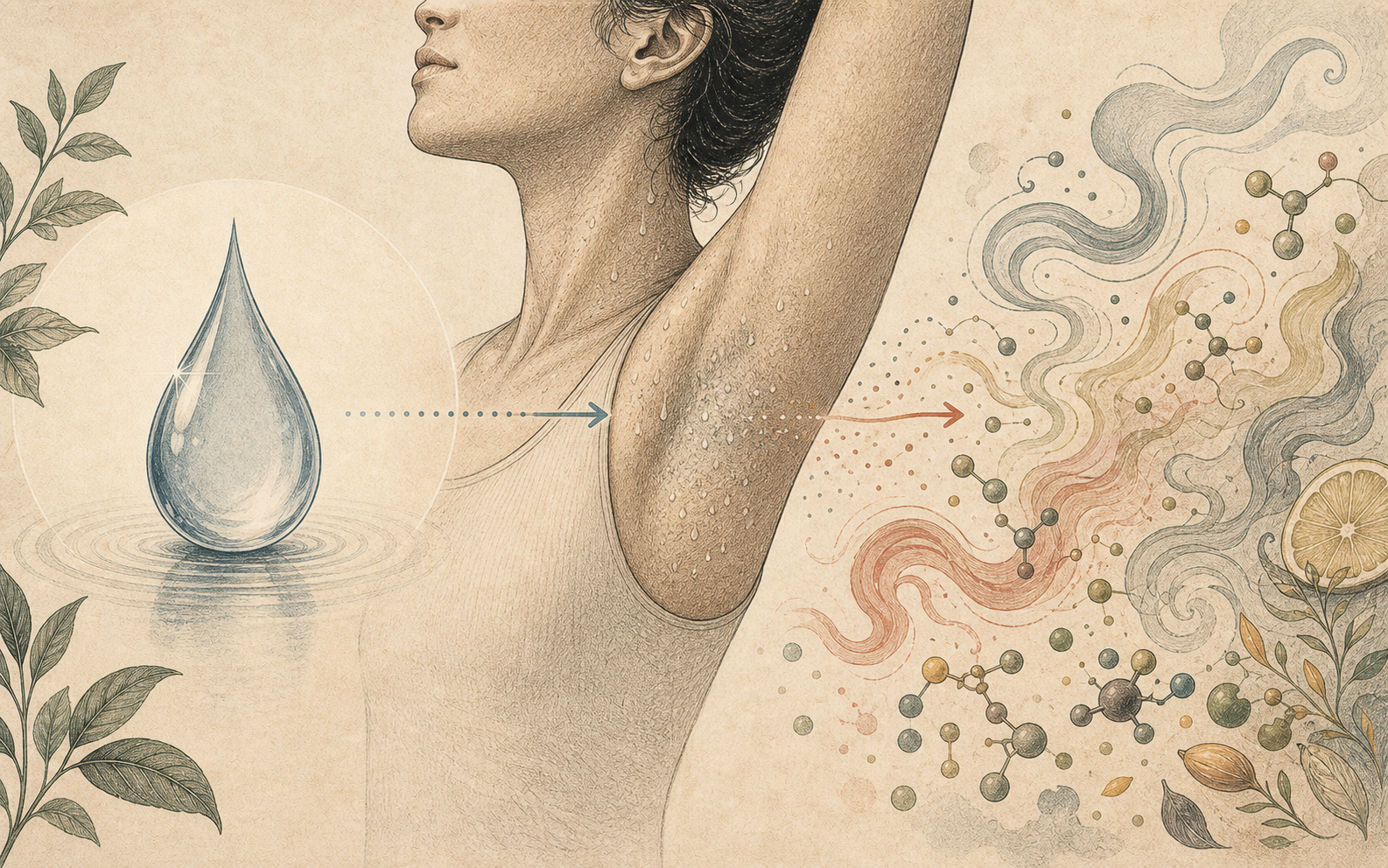
Odor starts with chemistry
Once odor is chemistry, shame starts to look less useful. Chemistry has no opinion about you. It is doing what chemistry does in a warm folded place.
Odor is real, and the response can be simple: wash the area, rinse clean, change the shirt when the shirt is the actual issue.
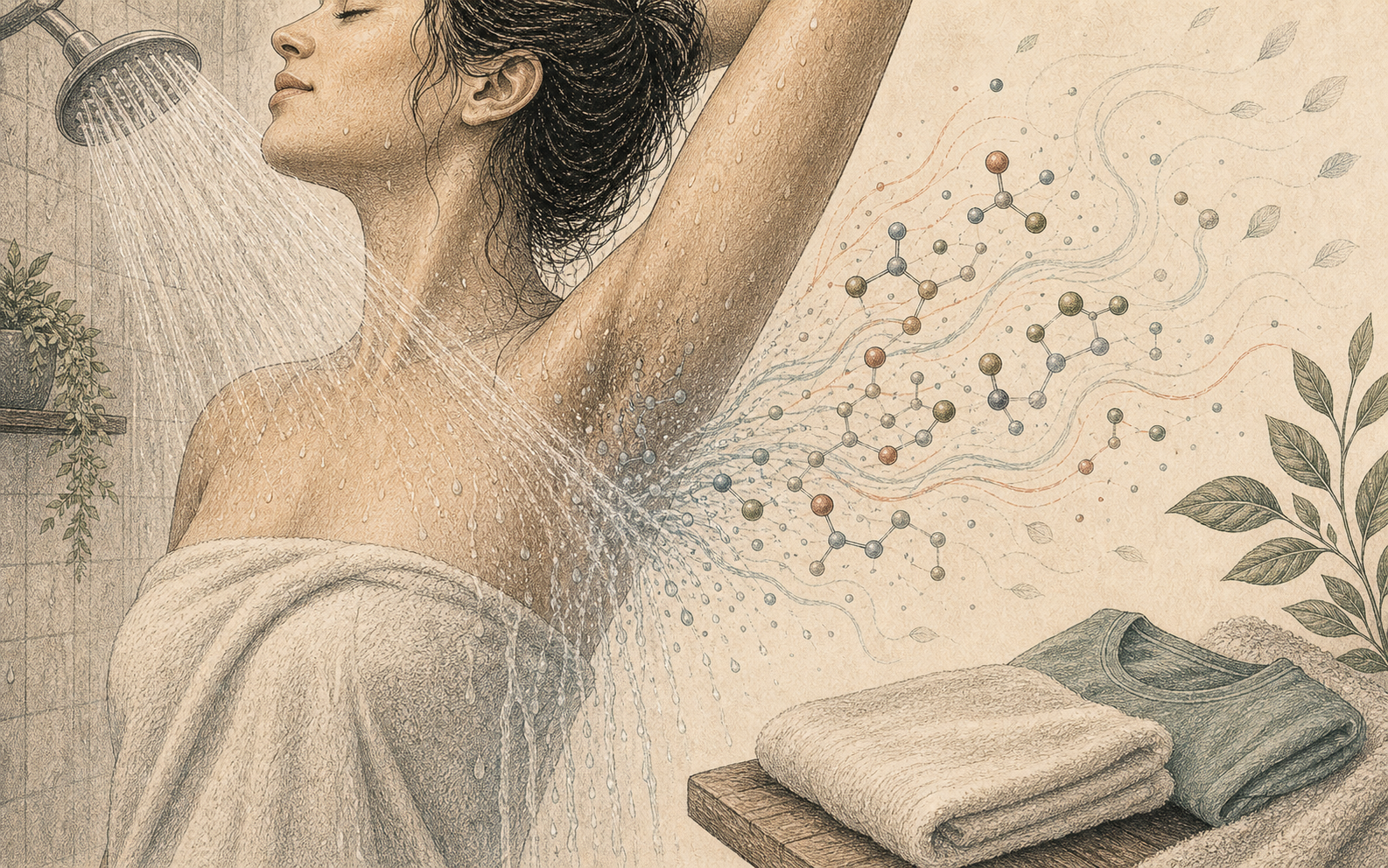
Wash before you cover
Traditional deodorant treats odor as something to cover: more scent, more swipe, more reapplication. If odor is a downstream reaction, covering it is only one possible move.
GoodSweat is a shower deodorant used in the shower before the shirt goes on. Squeeze on, massage in, rinse clean. Sweat keeps its cooling job; underarm care fits into the shower routine.
Sources
- "Sweating and body odor." Public medical overview of sweat glands, body odor, and the difference between eccrine and apocrine areas.
- Patel BC, Treister AD, McCausland C, Lio PA, Jozsa F. "Anatomy, Skin, Sudoriferous Gland." StatPearls, NCBI Bookshelf. Anatomy and physiology reference for sweat glands and thermoregulation.
- James AG, Austin CJ, Cox DS, Taylor D, Calvert R. "Microbiological and biochemical origins of human axillary odour." FEMS Microbiology Ecology, 2013;83(3):527-540. Primary axillary odor review supporting the low-odor precursor and microbial transformation explanation.
- Minhas GS, Bawdon D, Herman R, Rudden M, Stone AP, James AG, Thomas GH. "Structural basis of malodour precursor transport in the human axilla." eLife, 2018;7:e34995. Explains molecular transport of underarm malodor precursors and why odor can appear after transformation.