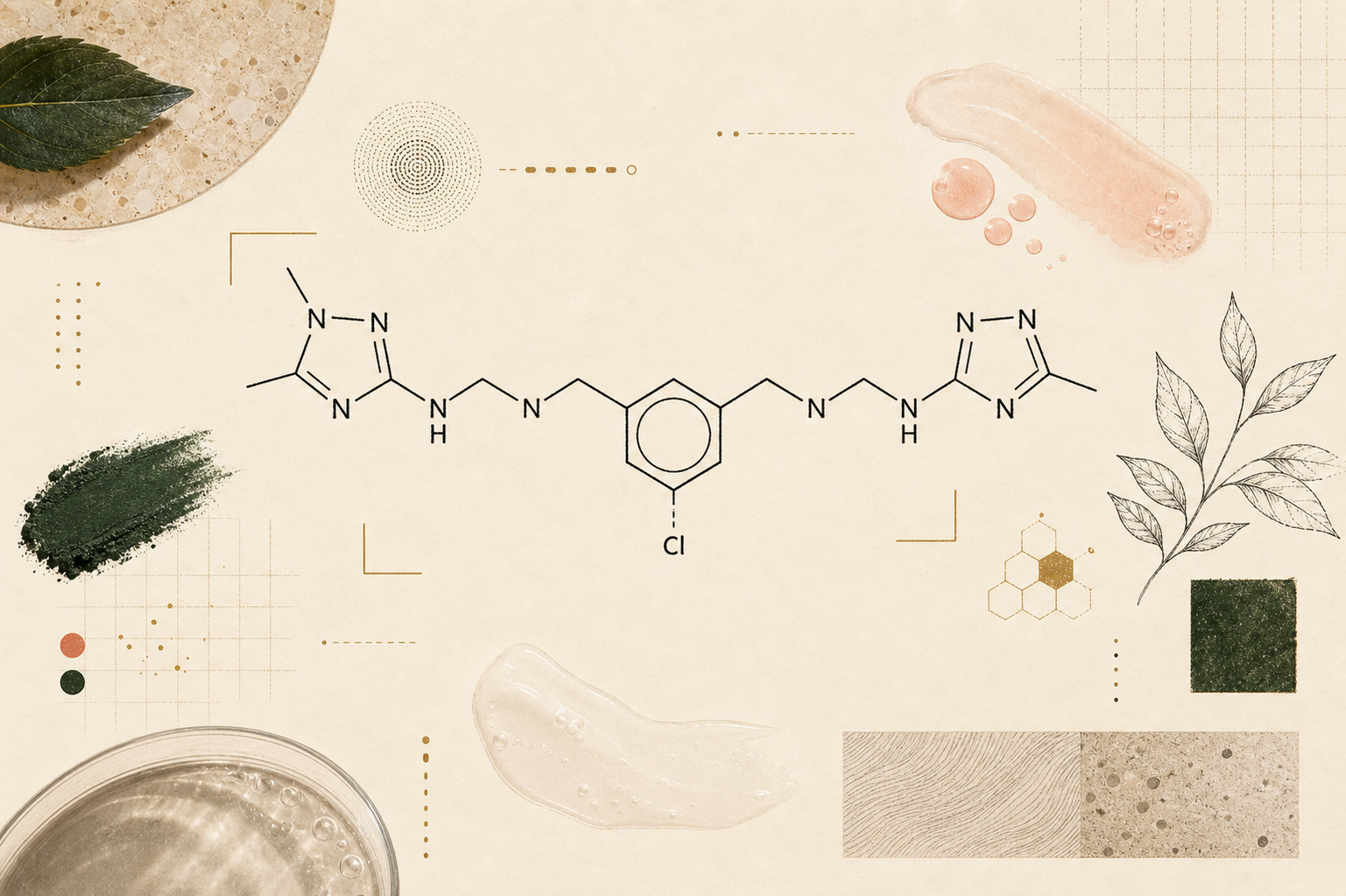
Meet octenidine
Octenidine is a small, well-built molecule with a quiet superpower: it does a serious job, and it does it gently. American chemists invented it. Europe spent four decades proving it could be trusted. That combination is rare.
Most ingredients trade one thing for another. Strong but harsh. Gentle but weak. Octenidine is the unusual one that does not seem to make you choose. It works at remarkably low strengths, it is well tolerated by skin, and it has a topical-care record stretching back to 1987. By the time you finish this page, the feeling you are meant to walk away with is simple: this is a good molecule, chosen on purpose.
The molecule
Picture a barbell. Two matching ends, joined by a long, slender bridge. That is octenidine: a symmetrical molecule with two identical heads linked by a chain of carbon. Chemists call this shape a gemini structure, from the Latin for twins. It is one of the tidiest, most balanced builds an antiseptic molecule can have.
The molecule also carries a positive electrical charge. This is where the elegance begins. The outer surfaces of unwanted microbes carry a negative charge, and opposites attract. Octenidine is simply drawn to those surfaces, settles onto the membrane, and disrupts it physically. No harsh chemistry, no poisoning. It works by attraction and physics, not brute force.
That gentle mechanism comes with two welcome consequences. First, octenidine is effective at strikingly low concentrations: studies report activity against Staphylococcus aureus at around 0.025 percent, where the older molecule chlorhexidine needed more than 0.2 percent to do similar work. A little goes a long way. Second, it barely crosses into the body. Absorption through skin is negligible, and it does not accumulate. It stays where it is put and then rinses away.
The molecule itself. The name you will see most often, and the one this page is about.
The same molecule in its salt form. "HCl" is a formulation detail, not a second ingredient.
So if you see octenidine, octenidine dihydrochloride, or Octenidine HCl on a label, relax: they all point to the same well-mannered molecule.
Built better, on purpose
Octenidine did not appear by accident. It was built to fix the shortcomings of what came before.
For decades, the workhorse skin antiseptic was chlorhexidine. It worked. But it carried real baggage. It can cause contact allergy, and in rare cases serious allergic reactions: in 2017 the FDA added an anaphylaxis warning to over-the-counter chlorhexidine skin-antiseptic labels. In mouth-rinse form it stains teeth and dulls taste. It is more toxic to human cells than newer options, and it comes with a longer list of use limitations.
Octenidine arrived a generation later as the gentler answer. The brief, more or less, was: keep the performance, lose the harshness. It delivers. The literature reports lower cytotoxicity than chlorhexidine, negligible absorption, no staining, effectiveness at far lower concentrations, and, as of the major reviews, no observed resistance. It is the rare follow-up that is genuinely an improvement on the original, not just a different name for the same thing.
This is the heart of why octenidine feels so likeable. Someone sat down to make an antiseptic molecule that was kinder to skin, and they succeeded.
The European chapter
Here is the part most people get backwards. Octenidine sounds European, almost continental. It was actually born in the United States. American chemists at the Sterling-Winthrop Research Institute, in upstate New York, invented it in the early 1980s. Denis M. Bailey is credited on the work; the US patent dates to 1980.
Then it crossed the Atlantic. Schülke & Mayr, a company in Hamburg, Germany, licensed the molecule and commercialized it as Octenisept. From 1987 onward, it became a familiar fixture of European topical care. And it stayed there, quietly, for the next forty years.

That long stay left a paper trail. Octenidine became one of the most-studied antiseptic molecules in European medicine, with German researchers leading much of the work. Hübner, Siebert and Kramer described it in 2010 as "a modern antiseptic for skin, mucous membranes and wounds" in Skin Pharmacology and Physiology. A 2023 review in Pathogens found that most of the studies it assessed came from European countries, with Germany the most prominent of all.
The arc is satisfying to say out loud: an American molecule, trusted across a continent for a generation, finally coming home.
Why it's in GoodSweat
When you go looking for an ingredient that is both effective and kind to skin, with decades of real-world use behind it, octenidine is exactly what you hope to find. GoodSweat chose it on purpose.
GoodSweat is a shower deodorant: a cream you use in the shower, on your underarms, and rinse clean. It is not a drug and it is not a treatment. It is a body-care step, and octenidine is the well-mannered molecule at the center of it. The gentleness matters here, because underarm skin is delicate and the routine happens often.
The phrase octenidine deodorant makes sense as a search, and GoodSweat is close to it: a shower deodorant. The difference is timing. A stick deodorant is a leave-on scent layer; GoodSweat is a rinse-off step you use in the shower, then rinse away before you get dressed without the sticky swipe.
That is the whole reason this story is worth telling. A good molecule, picked deliberately, makes for a shower deodorant you can trust against your skin.
What pairs with it
Octenidine does not work alone in the bottle. On the odor-focused side of the formula sits zinc oxide, a skin-friendly mineral. Glycerin and allantoin round things out for comfort and skin feel, so the cream leaves skin feeling like skin.

The routine is the simplest part. Squeeze a small amount onto each underarm, massage it in, leave it about a minute, then rinse clean with water, and get dressed without the sticky swipe. No soap on the underarms; water alone rinses it away. The molecule is decades in the making. The step takes less time than brushing your teeth.
Sources
- PubChem: Octenidine The compound record for octenidine, covering its molecular structure, identifiers, and classification as a cationic bispyridine compound.
- Hübner, Siebert & Kramer, 2010, Skin Pharmacology and Physiology Reviews octenidine as a modern antiseptic for skin, mucous membranes and wounds. Source for the low-concentration activity, negligible skin absorption, and gentler tolerability versus chlorhexidine.
- Köck et al., 2023, Pathogens Clinical-evidence review for octenidine; the basis for the observation that most assessed studies came from European countries, with Germany especially prominent.
- FDA Drug Safety Communication, 2017: chlorhexidine allergic reactions Source for the chlorhexidine anaphylaxis warning added to over-the-counter skin-antiseptic labels, used to describe the limits of the older molecule.
- FDA: Is It a Cosmetic, a Drug, or Both? Explains how intended use and claims separate a cosmetic from a drug, the framing that places GoodSweat in the shower-deodorant lane.
Octenidine is the quiet kind of remarkable: an American molecule, refined by forty years of trusted European use, that does a real job and is kind to skin while doing it. GoodSweat did not stumble onto it. It went looking for an ingredient exactly like this. The story is worth knowing. The step in the shower is simple: squeeze, massage, rinse, dressed.
Back to GoodSweat