Body literacy guide
Why stress sweat feels different
The sweat from a hard run and the sweat before a hard conversation come from different glands answering different signals. One is your body cooling down. The other is your body reacting. Neither one is a flaw.
Workout sweat cools you
Eccrine glands all over the body release watery sweat that evaporates and carries heat away. It is thin, and odor microbes barely notice it.
Stress sweat is richer
Apocrine glands in the underarm answer adrenaline with a thicker, protein-rich fluid. Odorless when fresh, but a better meal for microbes.
Odor is the part you can fix
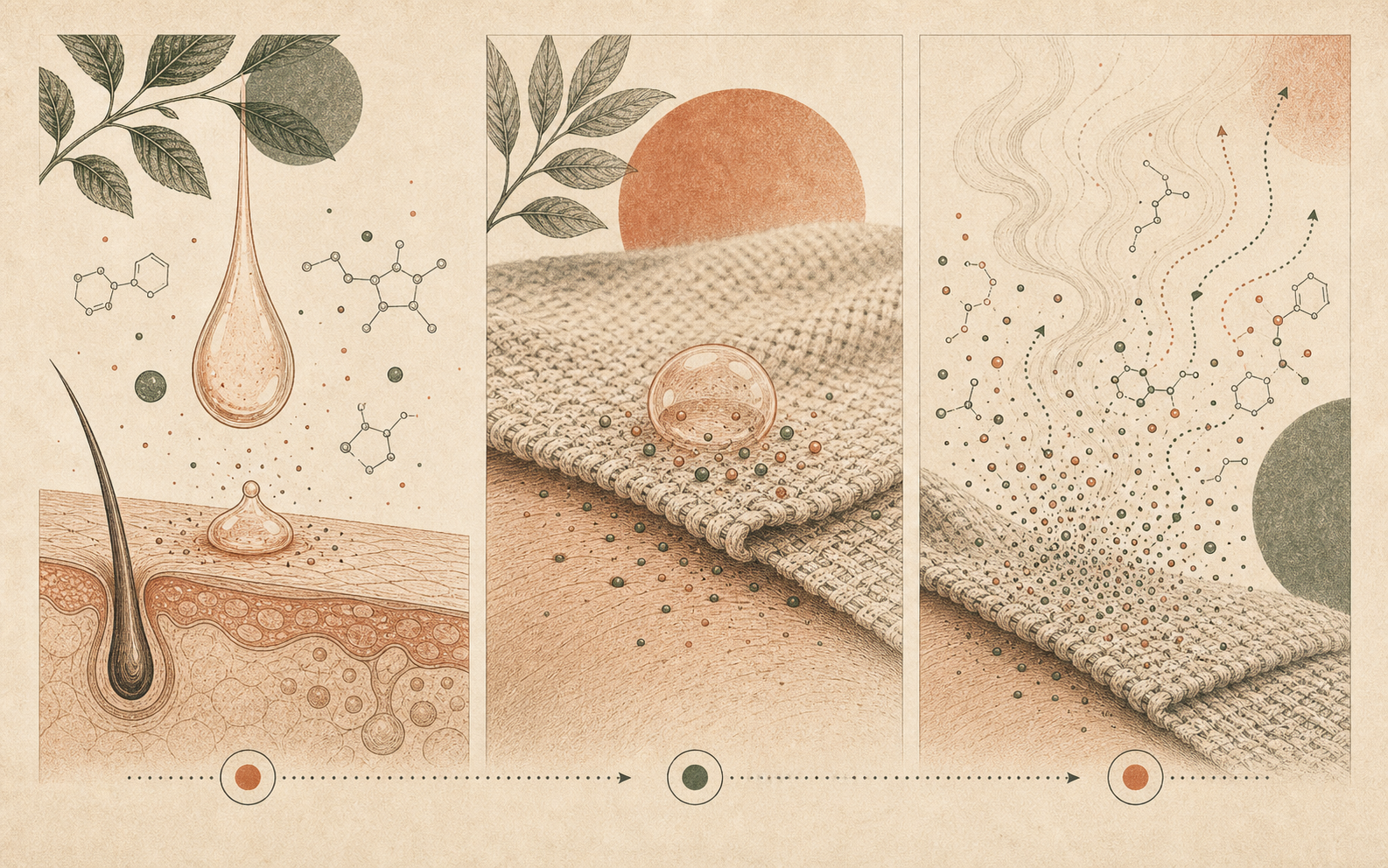
Smell forms later, on the skin, over time. That is the good news: it washes off. Sweat is not the enemy. Odor is.
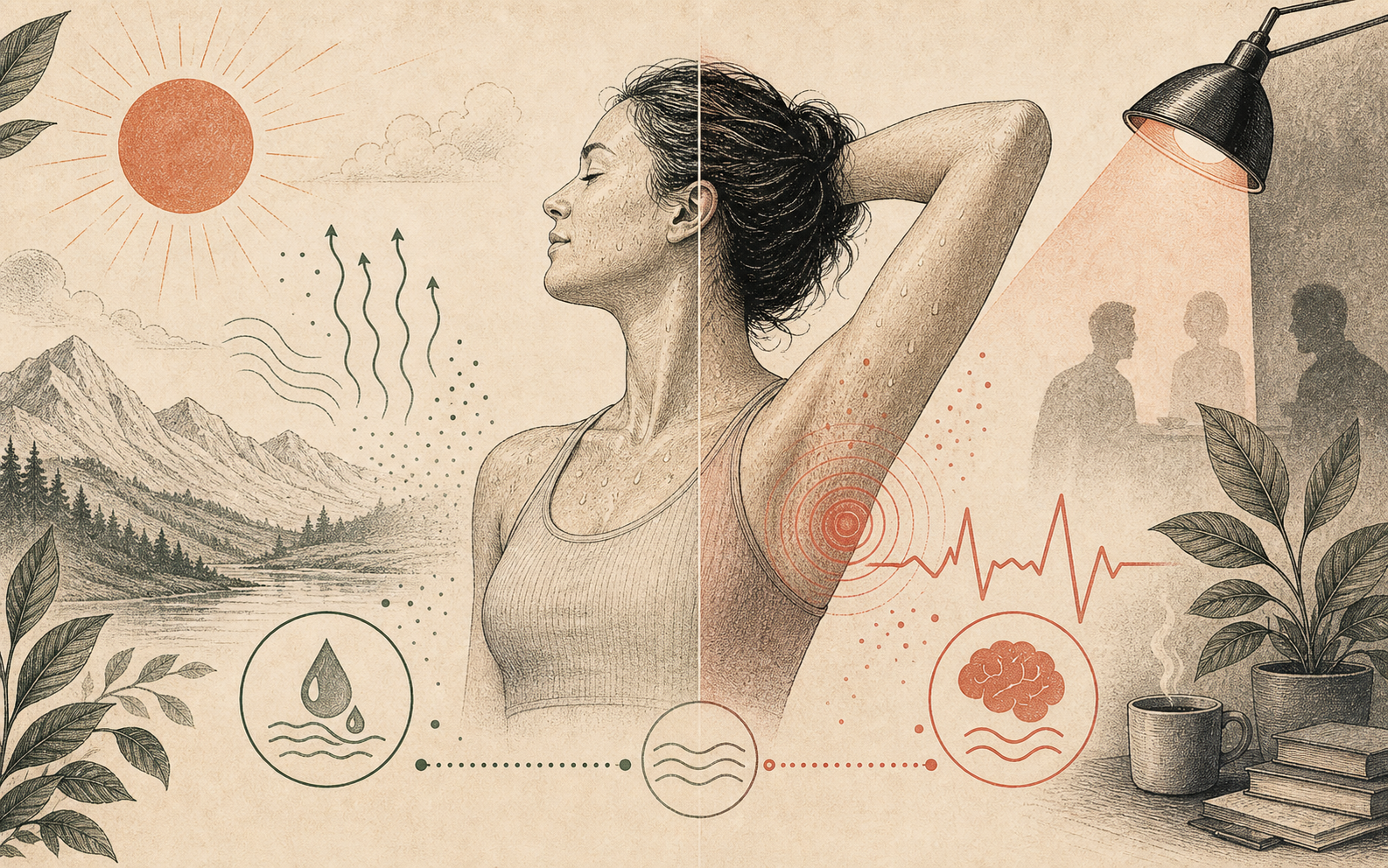
There is a kind of sweat that has nothing to do with the gym. It arrives before a presentation, mid-commute, while you wait for a reply, five minutes into trying to look completely fine. Here is the part worth holding onto: that sweat is normal, it is explainable, and your body is not betraying you.
Your body is reacting, not malfunctioning
Workout sweat is easy to forgive. You moved, you warmed up, you got damp. It makes sense. Stress sweat feels stranger because it can show up while you are sitting perfectly still, which can read like the body doing something wrong.
It is not. You have more than one sweat system, and they answer to different things. One responds to heat. One responds to feeling. The underarm is the rare patch of skin where both of them live, which is exactly why a nervous moment can feel like it landed there specifically. It did. That is the design, not a defect.
Workout sweat is just the cooling system
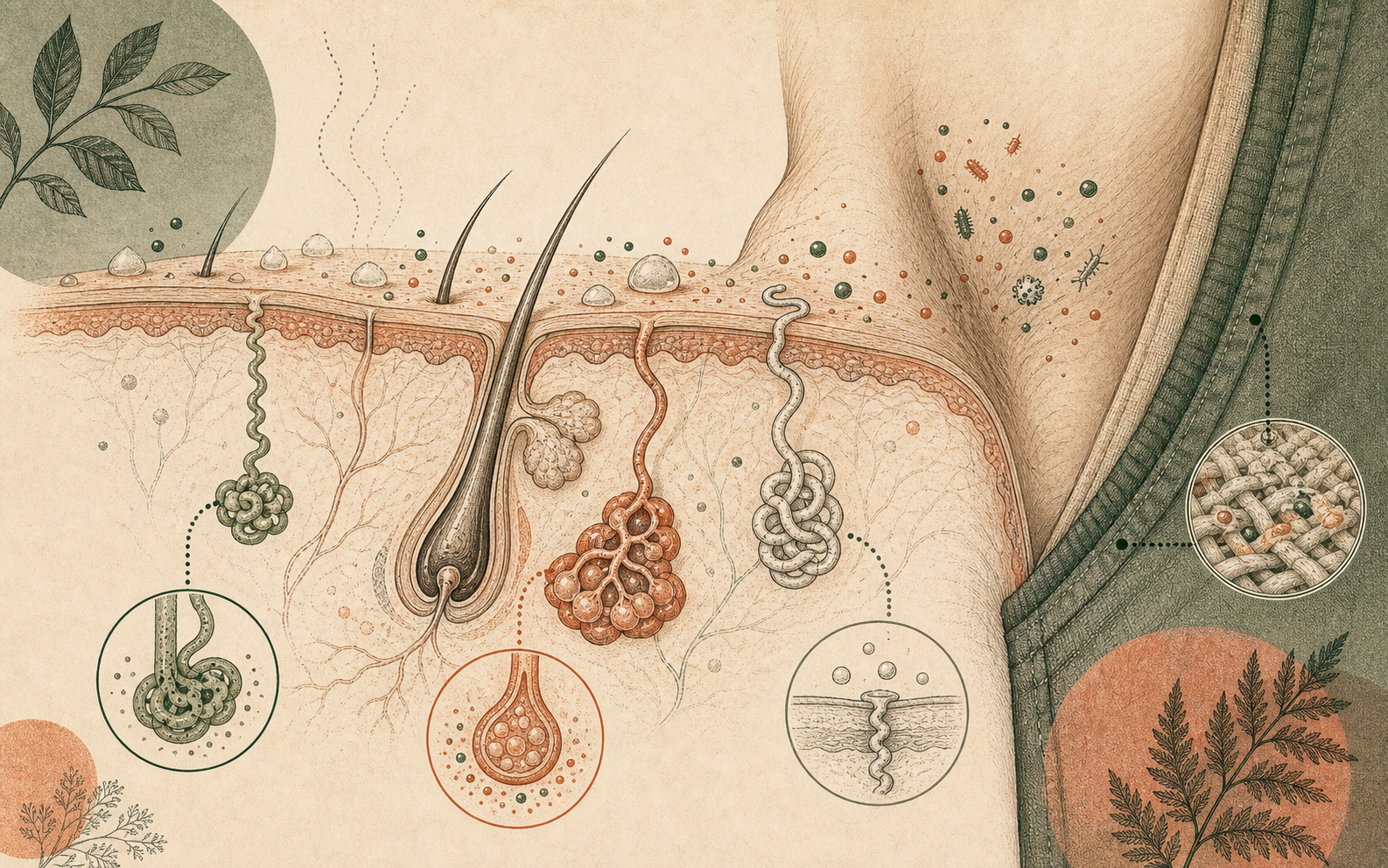
Most of what you picture after exercise is eccrine sweat. Eccrine glands are spread across nearly all of your skin and open straight onto the surface. When you heat up, from a run, a fever, a hot room, they release a thin, watery fluid so it can evaporate and pull heat off you.3
That is thermoregulation, and your body is very good at it. The fluid is mostly water and salt. It evaporates clean, and it gives odor microbes almost nothing to eat.
So the soaked-shirt feeling after a workout is not the same event as the damp underarm before a first date. We call both of them sweat and treat them as one problem. They are not.
Stress sweat is a richer kind of sweat
The underarm is specific skin. It is warm, folded, hair-bearing, low on airflow, and tucked into fabric most of the day. It is also home to apocrine glands, which open into hair follicles, switch on at puberty, and respond strongly to emotional signals like adrenaline.2, 3
What they release is different. Apocrine fluid is thicker and milky, rich in proteins and lipids, and, this is the part that matters, odorless when it is fresh.2, 3 The smell is not in the sweat. It comes later.
That richness is the whole reason stress sweat can seem louder than a hot afternoon. Watery eccrine sweat is a thin meal. Protein-rich apocrine sweat is a feast. Same skin, more for the microbes to work with. Less sweat can make more smell, which is genuinely good news, because it means the volume of sweat was never the point.
Stress sweat odor is a reaction, not a verdict
The usual story is four words: sweat plus bacteria equals stink. The fuller version is kinder, and more useful.
James and colleagues, writing in FEMS Microbiology Ecology in 2013, traced where the smell actually comes from. The skin's own microbes, mainly Staphylococcus and Corynebacterium, take those odorless secretions and break them into volatile fatty acids and thioalcohols. Those are the molecules you smell.4 Later work mapped the precise machinery the bacteria use to do it.5
Read that again, because it lifts a weight off. The smell is downstream chemistry. It is not proof your sweat was dirty, and it is not a comment on you. It is microbes doing ordinary microbe things to odorless raw material.
That is what people mean by stress sweat odor: not dirty sweat, not a moral signal, and not a personality trait. It is ordinary underarm chemistry getting more raw material during a tense moment.
This reframe quietly changes everything. If sweat is the enemy, the only answers are more product, more fragrance, another anxious swipe at lunch. If odor is the enemy, the answer is small and physical: clean the surface, and the reaction starts over.
So can people actually smell that you are stressed?
The honest answer is the reassuring one: not really, and not the way the fear imagines.
Dalton and colleagues, in PLOS ONE in 2013, collected exercise sweat and stress sweat from donors, then had people smell the samples while rating strangers in neutral videos. They did find small shifts in how stressed or likeable those strangers seemed, but the effects were subtle, depended on context, and varied by who was doing the smelling.1
That is a long way from someone smelling your nerves across a conference table. Human odor perception is faint, easily swayed, and rarely consciously decoded. There is no hidden signal leaking out of you that exposes how you feel. The story your anxiety tells about the room is almost always louder than anything the room can actually detect.
What is real is gentler: stress, sweat, and a little self-consciousness tend to travel together. Anyone who has changed shirts before a meeting already knows that. You do not need to fear your own chemistry. You just need a place to set it down.
The calm move is one step in the shower
The deodorant aisle taught a lot of us to treat a nervous afternoon like a body emergency: more scent, a midday reapply, a layer to hide behind. None of that touches where odor actually forms. It just covers it and hopes.
The simpler move is to go back to the start of the chain. Wash the underarm instead of masking it, rinse it clean, put on the shirt, and get on with your day. GoodSweat is a shower deodorant made for exactly that moment: squeeze on, massage in, rinse clean, then get dressed without the sticky swipe.
It will not stop you from sweating, and it is not trying to calm your nerves. Sweating is your body doing its job. What it gives you is smaller and steadier: a clean start, a calmer routine, and one less thing to read meaning into. Your stress sweat was never a character flaw. It was just biology meeting a tense moment, and biology rinses off.
Sources
- Dalton P, Maute C, Jaen C, Wilson T. "Chemosignals of Stress Influence Social Judgments." PLOS ONE, 2013. Source for the cautious framing that stress-sweat cues shift social judgments only subtly, by context, and varying by evaluator.
- Mayo Clinic. "Sweating and body odor." Public medical reference for eccrine and apocrine glands, emotional sweating, and how body odor forms on the skin.
- Patel BC, Treister AD, McCausland C, Lio PA, Jozsa F. "Anatomy, Skin, Sudoriferous Gland." StatPearls, NCBI Bookshelf. Anatomy support for eccrine thermoregulation, apocrine glands in hair-bearing skin, and their thicker secretions.
- James AG, Austin CJ, Cox DS, Taylor D, Calvert R. "Microbiological and biochemical origins of human axillary odour." FEMS Microbiology Ecology, 2013. Establishes underarm odor as microbial transformation of odorless secretions into volatile fatty acids and thioalcohols.
- Minhas GS, Bawdon D, Herman R, et al. "Structural basis of malodour precursor transport in the human axilla." eLife, 2018. Maps the molecular machinery axillary microbes use to convert odorless precursors into thioalcohol odor.