Body literacy
Eccrine vs. apocrine sweat glands
Your body uses eccrine glands for cooling. Apocrine glands add underarm-specific secretions around puberty. Odor usually appears later, when those secretions meet microbes, fabric, heat, and time.
The underarm has two sweat systems in one small area. Eccrine glands send watery sweat to the skin surface to cool you down. Apocrine glands send richer secretions through hair follicles. Fresh sweat is usually quiet. Odor builds later on the skin surface.
Eccrine glands
Open directly to the skin surface. They sit across most of the body and regulate heat by releasing sweat that evaporates.
Apocrine glands
Open mostly into hair follicles in a few specific areas, including the underarms. Present early in life, but they only start meaningful secretion around puberty.
Odor
Later chemistry. Microbes turn low-odor gland secretions on the skin surface into volatile molecules our noses can detect.
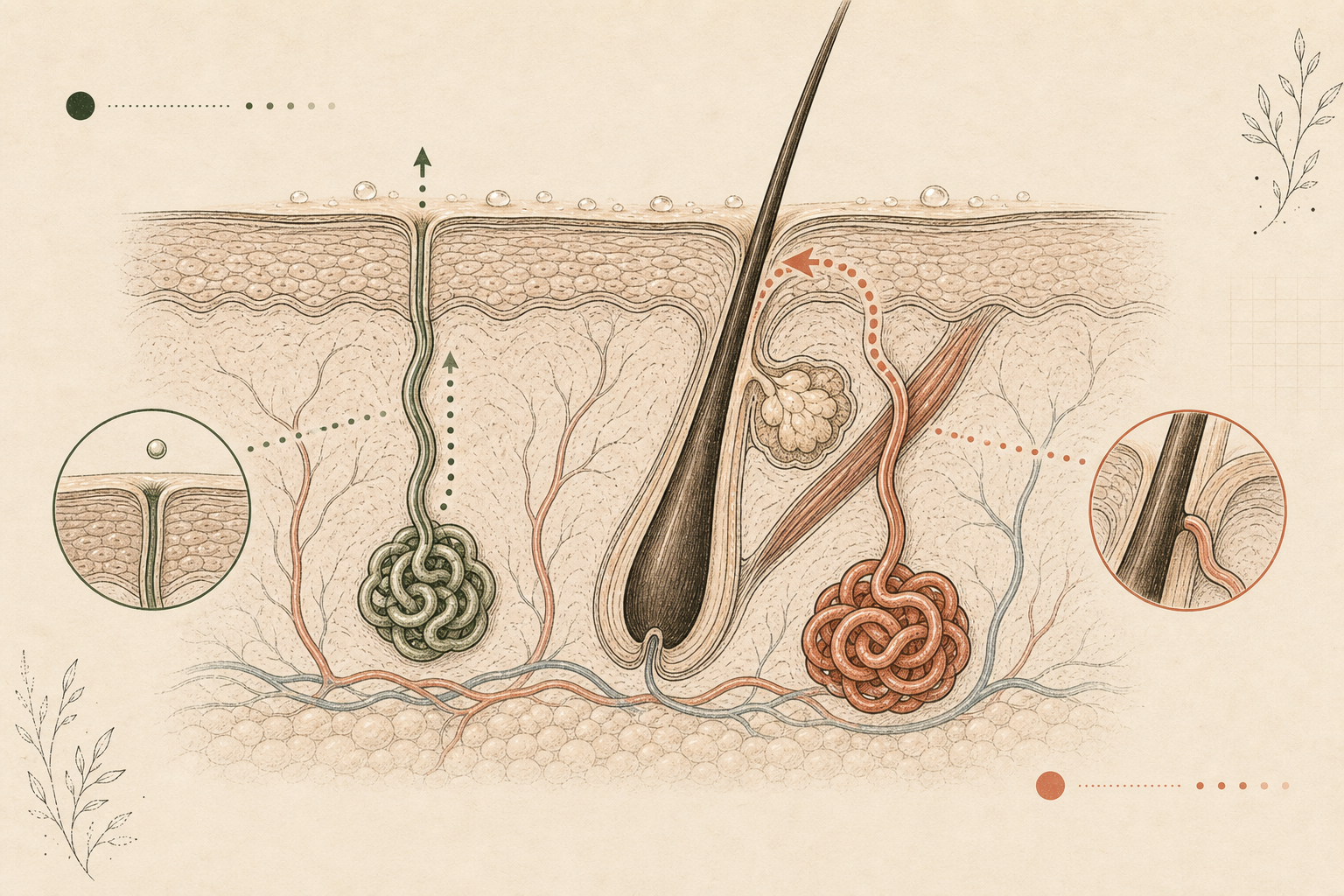
The cooling glands: eccrine
Eccrine glands are the body-wide sweat network. Anatomy references place them through most human skin, with especially high density on the palms and soles, and describe them as ducts that open directly onto the skin surface.1 Their job is practical: when core temperature rises, eccrine sweat reaches the surface and evaporation carries heat away.
Eccrine sweat starts as a watery fluid with electrolytes. As it moves through the duct, the gland reabsorbs much of the sodium and chloride before the sweat ever reaches the outside.1 Sweat tastes salty, but its salt level shifts with sweat rate, body region, heat acclimation, and how the sample was collected.
A useful distinction: wetness and odor are different signals. A long run, a crowded train platform, or nervous palms can produce plenty of eccrine sweat. That water changes the local environment, but classic underarm odor usually needs more than water.
The underarm specialists: apocrine
Apocrine glands are more selective. They cluster in the axillae, anogenital region, areolae, external ear canal, and eyelids, and their ducts generally empty into the hair-follicle system rather than straight onto open skin.2 In the underarm, their secretions arrive into a fold with hair follicles, skin oils, friction, fabric, humidity, and a resident microbial community.
They are also developmentally timed. Apocrine glands are present in childhood but usually become active around puberty, when hormonal changes bring axillary hair, adult underarm odor, and oilier skin online.2, 3
That shift is a normal change in the materials your skin has to work with, not a hygiene failure. Childhood sweat and adolescent underarms feel different because the gland mix and hormone context have changed.

What sweat is made of
The watery part of sweat gets all the attention because it is visible. But sweat also carries small solutes: electrolytes (sodium, chloride, potassium), metabolites like lactate and urea, and trace amounts of other compounds that vary by gland type, body region, and how the sample was collected. Baker's 2019 review of sweat gland physiology in Temperature argues that sweat composition is useful to study but a poor readout of what is happening in blood or the whole body.4
The plain version: sweat is mostly about temperature control and skin surface conditions. It can tell researchers something about a body region or a day, but it works poorly as a simple detox pathway.
Where odor starts
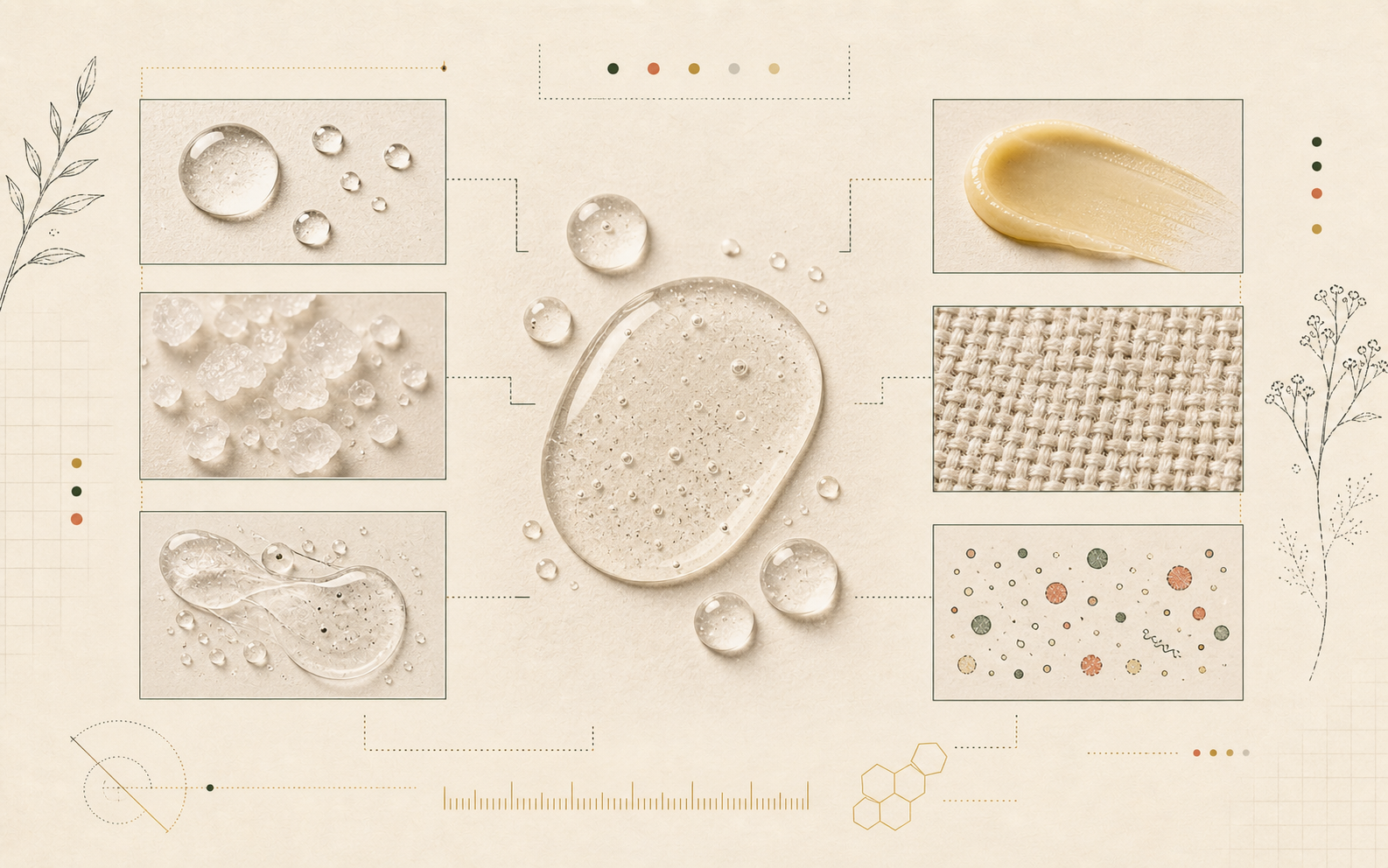
Body odor usually starts after low-odor secretions reach the skin surface. A 2013 review by James and colleagues in FEMS Microbiology Ecology describes axillary malodor as microbial biotransformation of odorless natural secretions into volatile odorous molecules, with underarm microbes feeding on materials from eccrine, apocrine, and sebaceous glands.5
The volatile molecules James and colleagues catalogue include short- and medium-chain fatty acids, sulfur-containing compounds, and steroid-derived odorants. The mix shifts with the microbial community, the precursor molecules available, and the fabric and airflow on top. Two people can sweat similarly and smell completely different. Your own underarms can change across heat, stress, menstrual cycle phase, medication changes, or a long day under polyester.
This is the useful frame: underarm odor is a local, changeable interaction between gland output and skin context. Odor is the enemy, not sweat. The practical move is to manage the surface chemistry and rinse away what has built up.
The underarm as a small piece of terrain
Underarms are warm, covered skin folds. They hold eccrine glands, apocrine glands, skin oils, hair follicles, and a resident microbial community adapted to the fold. That same skin also gets deodorant residue, detergent residue, shirt fibers, exercise, synthetic fabric, and humidity.
When odor changes, look at the conditions: heat, airflow, fabric, puberty, stress, a new laundry detergent, or an over-scrubbed skin barrier. Any of these can shift the chemistry. Reading the local context gives you more levers than shame ever did.
Four myths worth retiring
Myth: Sweat smells bad.
Fresh sweat and gland secretions are often odorless or close to it. Odor develops when skin-surface chemistry turns those materials into volatile molecules.
Myth: More sweat always means more odor.
Not necessarily. A lot of watery eccrine sweat can be less odor-prone than a smaller amount of apocrine-rich underarm secretion in the right skin context.
Myth: Puberty odor means someone is unclean.
No. Adrenarche and puberty change gland activity, skin oiliness, hair, and odor precursors. The body is updating its raw materials.
Myth: The goal is to stop sweat.
Sweat helps regulate temperature. Better underarm care separates wetness, gland type, skin context, and odor.
The map in plain language
Eccrine glands cool you. Apocrine glands add underarm-specific material after puberty. Odor gets made later, on the skin surface, by local chemistry. That is why underarm care in the shower can be more useful than adding another leave-on layer.
Sources
- Patel BC, Treister AD, McCausland C, Lio PA, Jozsa F. Anatomy, Skin, Sudoriferous Gland. StatPearls, NCBI Bookshelf. Defines eccrine and apocrine gland anatomy, gland openings, distribution, thermoregulation, and sweat electrolytes.
- Fakoya AO, Murphrey MB, Safadi AO, Vaidya T. Histology, Apocrine Gland. StatPearls, NCBI Bookshelf. Explains apocrine locations, hair-follicle association, larger gland structure, and puberty-linked onset of secretion.
- Witchel SF, Topaloglu AK. Normal and Abnormal Puberty. Endotext, NCBI Bookshelf. Gives puberty and adrenarche context, including axillary hair, adult apocrine odor, and oilier skin.
- Baker LB. Physiology of sweat gland function: The roles of sweating and sweat composition in human health. Temperature. 2019;6(3):211-259. Reviews sweat composition, thermoregulation, and the limits of treating sweat as a simple biomarker or detox pathway.
- James AG, Austin CJ, Cox DS, Taylor D, Calvert R. Microbiological and biochemical origins of human axillary odour. FEMS Microbiology Ecology. 2013;83(3):527-540. Reviews microbial transformation of odorless secretions, underarm microbiota, and volatile odor molecule classes.