Textile field guide
Why do gym shirts smell worse than bodies?
Sometimes the smell is coming from the shirt more than the body. Fabric holds sweat, oils, deodorant residue, odor molecules, and laundry history.
The shirt participates
Sweat, skin oils, odor molecules, and skin microbes move from your body into fabric.
Polyester behaves differently
Its surface chemistry can favor odor release, sebum retention, and textile microbial patterns that differ from cotton.
Skin care and laundry do different jobs
Cleaning the underarm in the shower is a skin job. A shirt with built-in odor needs laundry help.
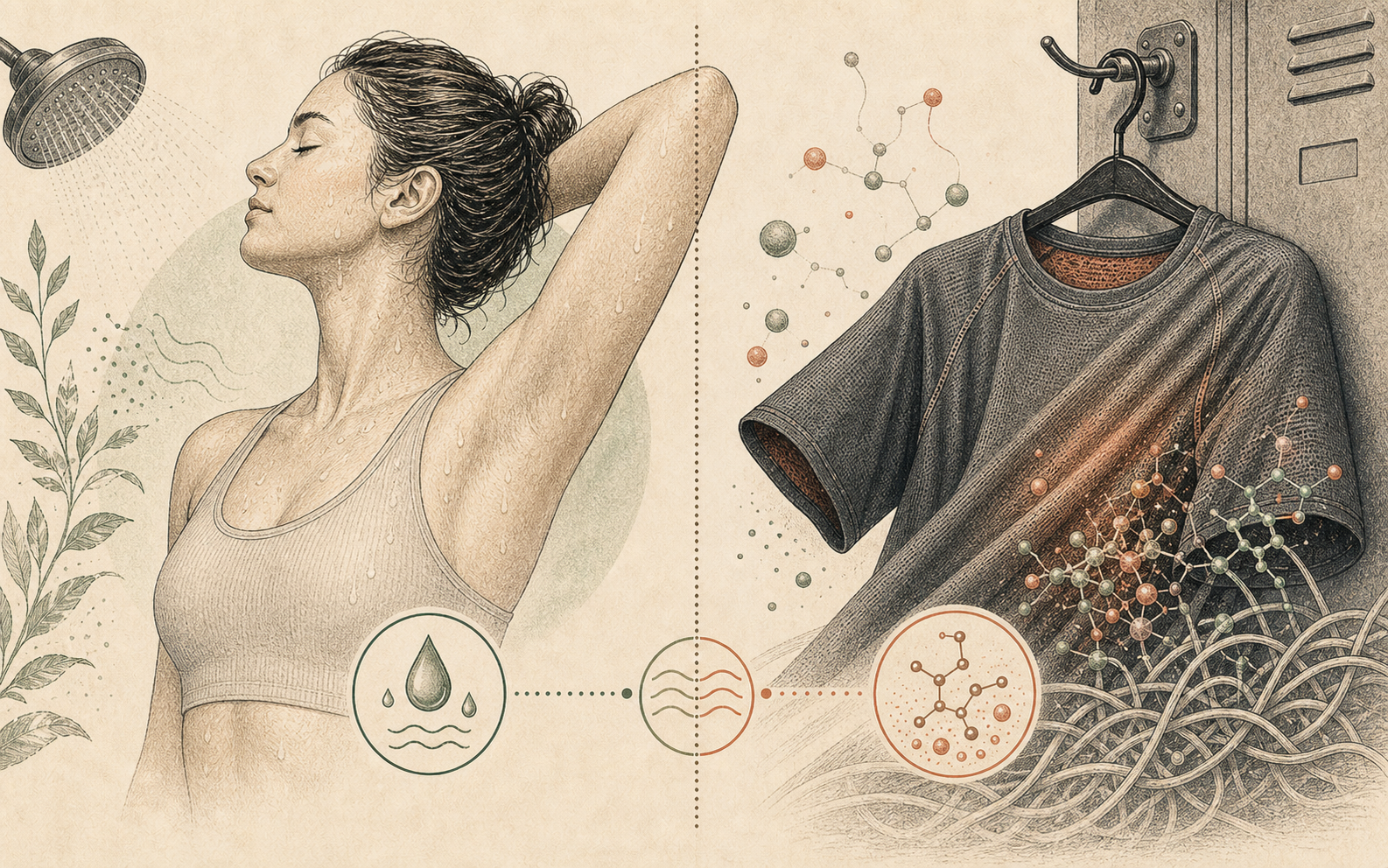
You can shower after a workout and still have yesterday's shirt bring the smell back. Sometimes it appears as soon as the fabric warms up. Sometimes it waits for the first commute sweat.
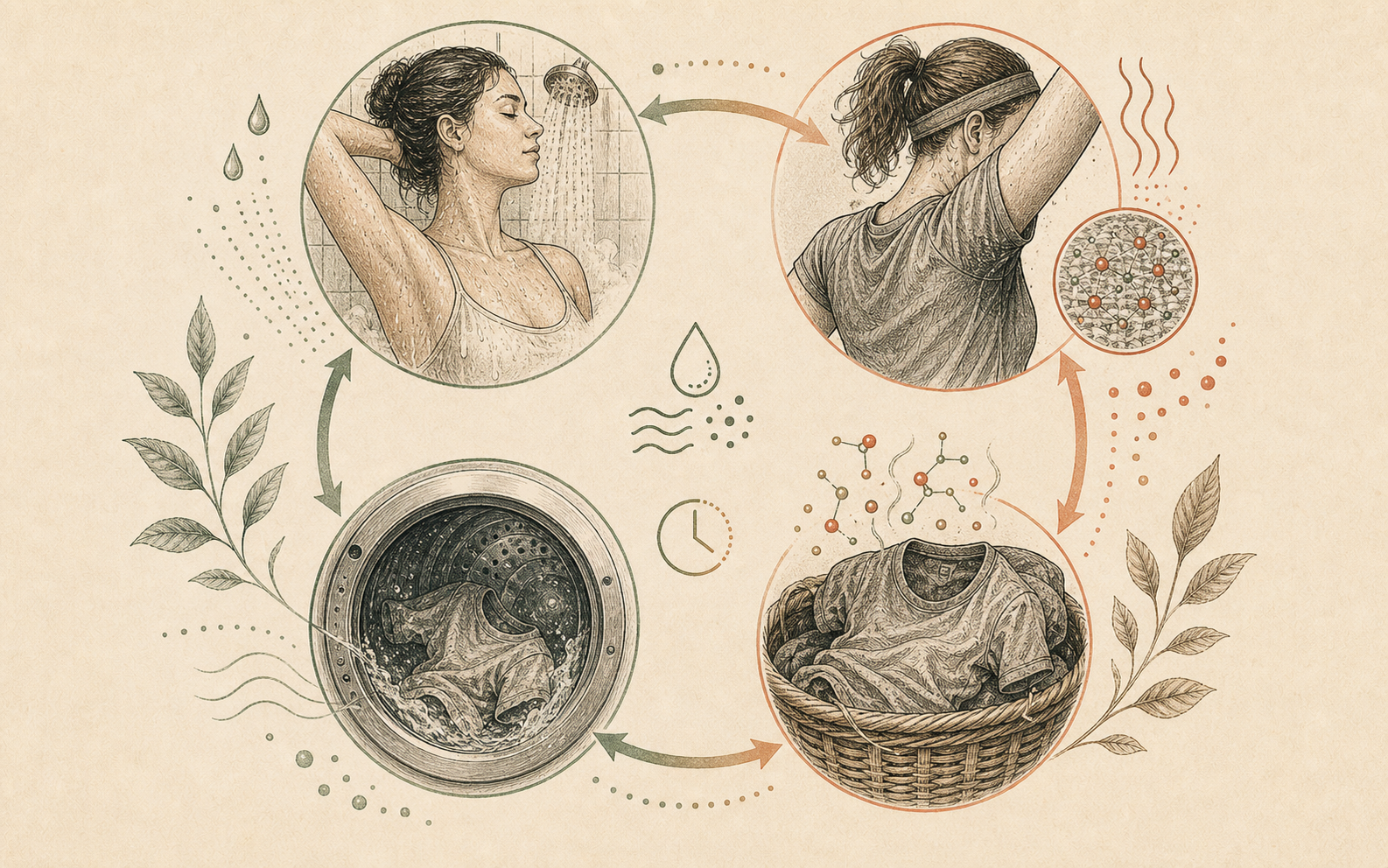
If the question is why do gym shirts smell even after washing, the answer is usually a loop, not a single culprit. Skin, fabric, heat, detergent, drying time, and yesterday's product can all leave traces that wake back up when the shirt gets warm.
The shirt is part of the odor system
The smell feels personal because the shirt is touching your body. The story is bigger than that.
When fabric sits against the underarm, it collects sweat, skin oils, odor molecules, shed skin, and microbes from the skin. That does not make your body dirty. It means fabric absorbs, holds, releases, and sometimes keeps odor chemistry going after you take the shirt off.
Skin is alive, rinsable, and constantly renewing. A shirt is a textile. Once odor precursors, body soils, and microbes get into its structure, they behave differently than they do on skin.
That is why a body can be clean while a gym shirt still smells like it has a memory.
Polyester changes the odor profile
Most performance shirts are built around synthetic fibers, especially polyester. There's a reason: it can be light, stretchy, durable, and quick-drying. It can make a workout shirt feel less swampy than a soaked cotton tee.
But odor depends on more than drying speed. It depends on what the fiber holds, what it releases, and what kind of microbial life it encourages.
In a 2014 study by Callewaert and colleagues, 26 healthy people wore T-shirts during a one-hour spinning session; researchers compared cotton, synthetic, and mixed shirts after an incubation period. A trained odor panel rated the polyester shirts as less pleasant and more intense than cotton. The researchers also found different microbial patterns on cotton versus synthetic textiles, with micrococci showing up strongly on synthetic shirts.1
That is the part most people miss. The shirt does more than catch body odor. The fabric helps shape the odor profile.
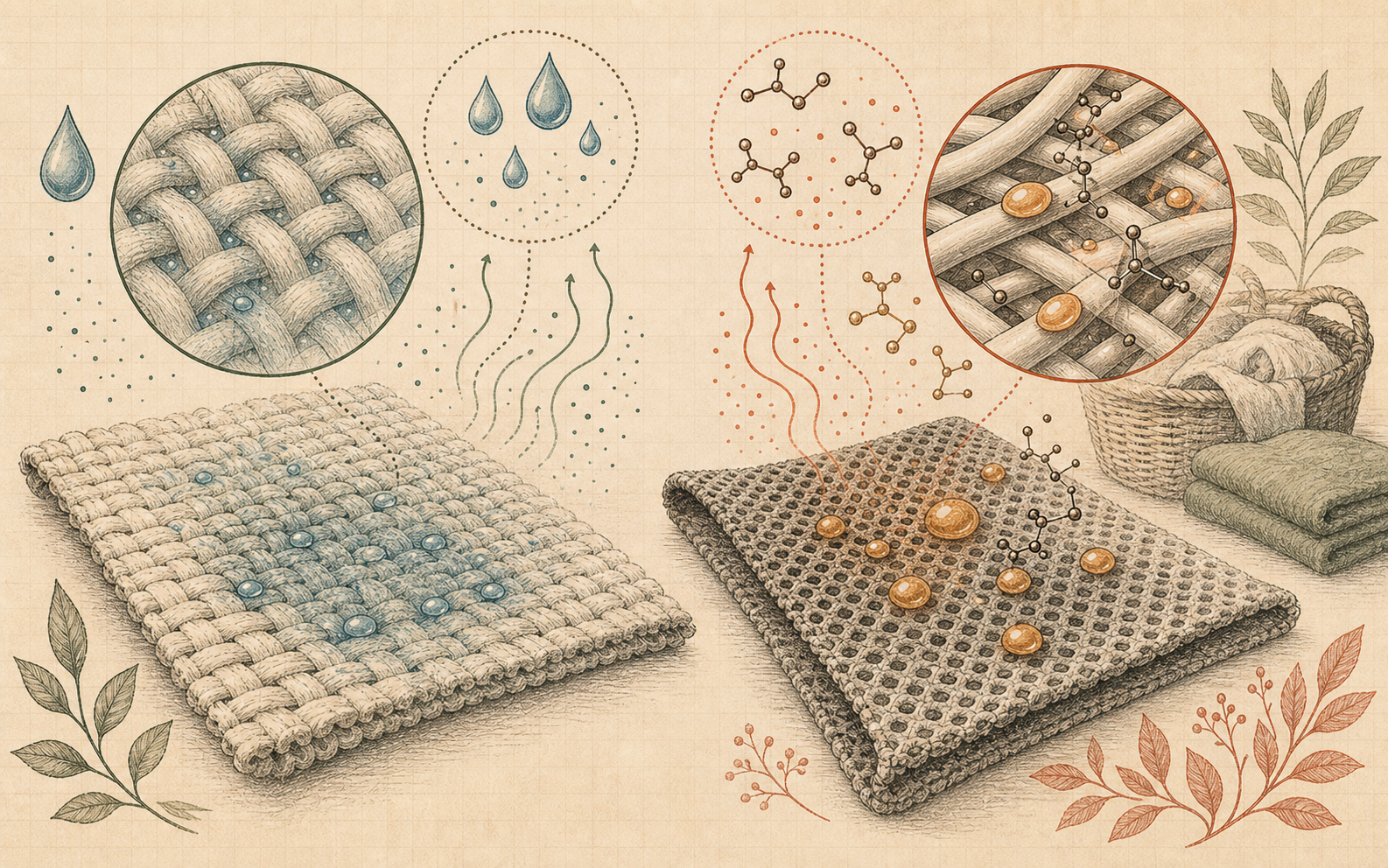
Skin smell and shirt smell behave differently
Underarm odor starts with biology. The axilla is a warm, folded, hair-bearing zone with sweat glands, oil, moisture, friction, and a resident microbiome. James and colleagues, in a 2013 review for FEMS Microbiology Ecology, describe the familiar pattern: natural secretions get transformed by skin microbes into volatile odor molecules, including volatile fatty acids and sulfur-containing compounds.6
The shirt side is different. Once sweat, sebum, odorants, and microbes transfer into fabric, the textile has its own rules. Fiber type, knit structure, drying time, detergent, and previous wear all change what happens next.
Van Herreweghen and colleagues (2020) describe clothing odor as a process shaped across the textile lifecycle. Skin contact transfers microorganisms, volatiles, and odor precursors. Washing and drying reshape the textile microbiome. Fabric properties influence what stays and what gets released.2
So if your shirt smells sharper or stranger than your skin after a shower, that is real. The fabric has been participating.
The rebloom problem
The most annoying gym-shirt smell often comes after laundry, when a clean shirt warms up and the old note returns.
You wash the shirt. It seems fine. Then your body warms it and a familiar underarm note appears, as if the shirt had been waiting for an invitation.
McQueen and colleagues followed cotton and polyester knit fabrics through 20 wear/wash cycles of physical activity. Polyester was rated significantly higher in odor intensity than cotton, before and after washing. Some carboxylic acids, a class of odor-relevant compounds, were also less effectively removed from polyester.5
That gives a name to the thing people call "permastink": textile accumulation doing what textile accumulation does.
No fabric tells the whole story
This isn't a sermon against technical fabrics.
Cotton smells, wool smells, and any shirt worn close to a sweating body can pick up odor. Human bodies, workouts, and laundry machines all vary, and a heavy cotton shirt left damp in a gym bag can get loud too.
But fiber chemistry matters. Møllebjerg and colleagues (2021) suggest fiber properties can influence bacterial adhesion, drying, and washing behavior on textiles.3 Abdul-Bari et al. (2022) found that repeated soil and wash procedures left tested odorants behaving differently in cotton and polyester fabrics.4
The useful version is simple: shirt smell is a system. Body, fabric, heat, time, and laundry history are all involved.
Where GoodSweat belongs in the loop
GoodSweat does not do laundry. If a shirt already has built-up textile odor, a shower product will not clean the fabric. That problem lives in the garment, the wash routine, the drying conditions, and sometimes the decision to retire the shirt.
GoodSweat belongs on the skin side of the loop. The underarm is where the shirt meets sweat, oils, deodorant residue, friction, and warmth. That is why deodorant residue on shirts matters: the layer you meant for skin can become part of the fabric story too. GoodSweat is the first shower deodorant, used in the shower so underarm care happens before the next shirt goes on. Squeeze on, massage in, rinse clean, get dressed.
The real answer
Gym shirts can smell worse than bodies because fabric holds onto a version of you after you've moved on.
Polyester can retain oily soils and odorants, release odor compounds into the air, and host textile microbial patterns that differ from skin. Repeated wear and wash cycles leave odor behind even when the shirt looks clean. Heat and new sweat bring that smell back.
Start with clean skin, choose shirts with fabric odor in mind, and stop asking a deodorant stick to perfume a fabric problem it cannot reach.
Sources
- Callewaert C, De Maeseneire E, Kerckhof FM, Verliefde A, Van de Wiele T, Boon N. "Microbial odor profile of polyester and cotton clothes after a fitness session." Applied and Environmental Microbiology, 2014. Primary anchor for odor-panel findings comparing polyester and cotton shirts after exercise.
- Van Herreweghen F, Amberg C, Marques R, Callewaert C. "Biological and Chemical Processes that Lead to Textile Malodour Development." Microorganisms, 2020. Review of how textile odor develops through skin transfer, fabric properties, washing, drying, and textile microbiome dynamics.
- Mollebjerg A, Palmqvist N, Lindblom M, et al. "The Bacterial Life Cycle in Textiles is Governed by Fiber Hydrophobicity." Microbiology Spectrum, 2021. Supports the discussion of fiber hydrophobicity, bacterial adhesion, drying, washing, and cotton/polyester differences.
- Abdul-Bari MM, McQueen RH, de la Mata AP, Batcheller JC, Harynuk JJ. "Retention and release of odorants in cotton and polyester fabrics following multiple soil/wash procedures." University of Alberta ERA, 2022. Supports the idea that odorants can behave differently in cotton and polyester after repeated soil and wash cycles.
- McQueen RH, Harynuk JJ, Wismer WV, Keelan M, Xu Y, de la Mata AP. "Axillary odour build-up in knit fabrics following multiple use cycles." International Journal of Clothing Science and Technology, 2014. Supports the 20-cycle wear/wash discussion and polyester odor-intensity findings.
- James AG, Austin CJ, Cox DS, Taylor D, Calvert R. "Microbiological and biochemical origins of human axillary odour." FEMS Microbiology Ecology, 2013. Skin-side anchor for axillary odor as microbial transformation of natural secretions into volatile odor molecules.
- McQueen Textile Research Group. "Odour in Textiles." University of Alberta. Academic research-group bibliography for textile odor studies and related scholarship.