Body literacy guide
Why stress sweat starts in your hands
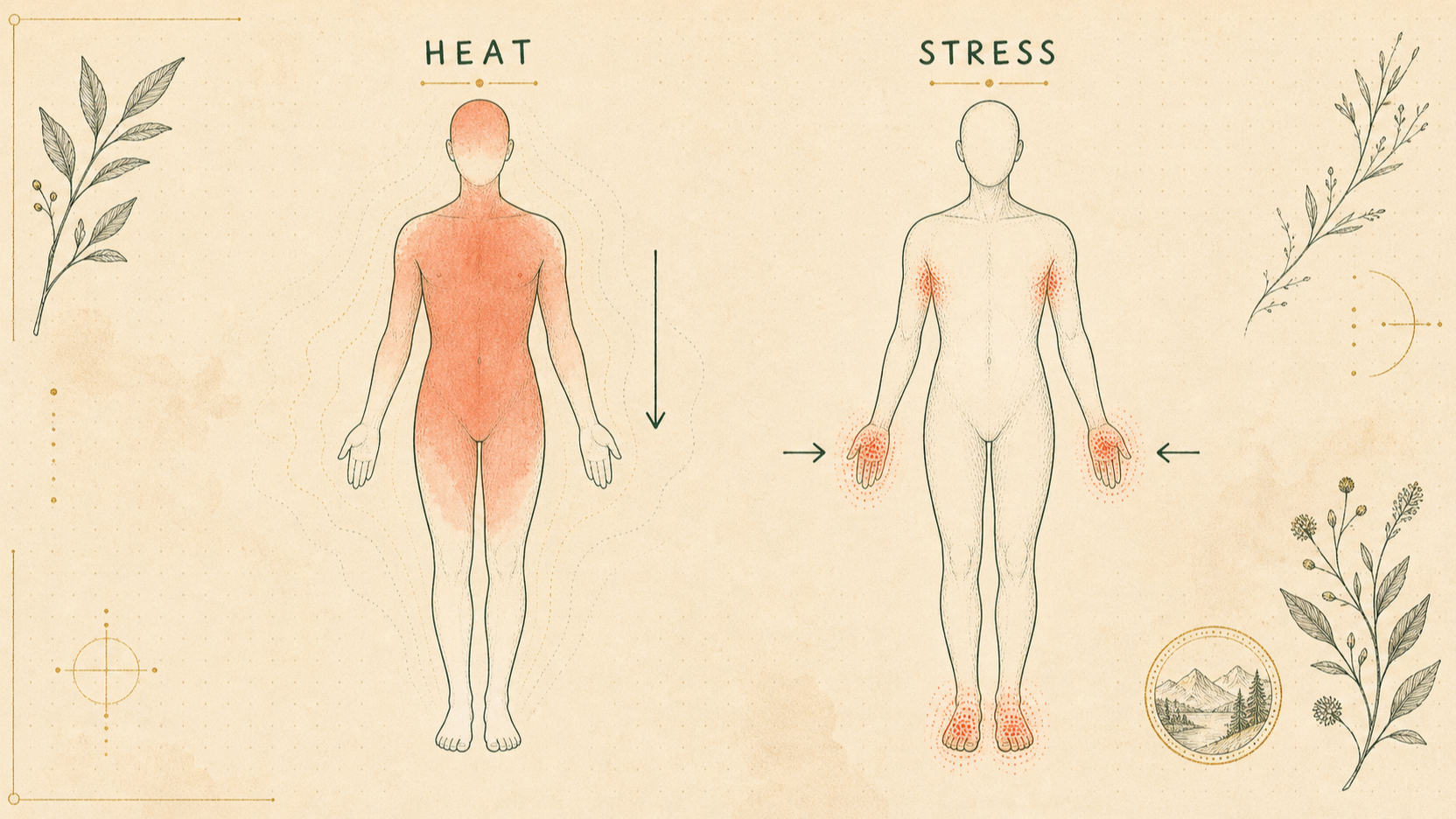
Heat sweat starts at your scalp and works down. Stress sweat does the reverse — it goes straight for your palms, soles, and underarms, often before the rest of you feels a thing. Here’s why.
Heat sweat starts at the top
When you overheat, sweating usually begins on the scalp and forehead and works down. Palms and soles are nearly the last to join in.
Stress sweat starts at the edges
A tense moment goes straight for the palms, soles, and underarms, often before the rest of you feels a thing.
Same skin, different signal
One is your thermostat cooling you down. The other is an older alarm getting you ready. Neither one is a flaw.
There is a sweat that has nothing to do with the weather. It shows up in your hands before a handshake, on the soles of your feet in a waiting room, under your arms the second your name is called. It is fast, specific, and a little uncanny. And once you can see the map it follows, it stops feeling like a malfunction.
Two kinds of sweat, two routes
Most of us treat sweat as one thing. You get damp, you worry, you cover it. But your body runs two different sweat programs, and they do not even start in the same place.
Heat sweat is the cooling system. When you warm up, sweating tends to begin on the forehead and scalp and spread downward across the body, with the palms and soles among the last regions to join in.3 It is wide, patient, and built to shed heat.
Stress sweat runs the route in reverse. A nervous moment goes first for the palms, the soles, the face, and the underarms, the spots packed with the most sweat glands, and it can fire there while the rest of you stays perfectly dry.1 It is fast and narrow, and it is aimed.
So the damp palm before a presentation and the soaked back after a run are not the same event wearing the same name. They begin in different corners of the same body, because they were sent by different parts of the brain.
Your body has two thermostats
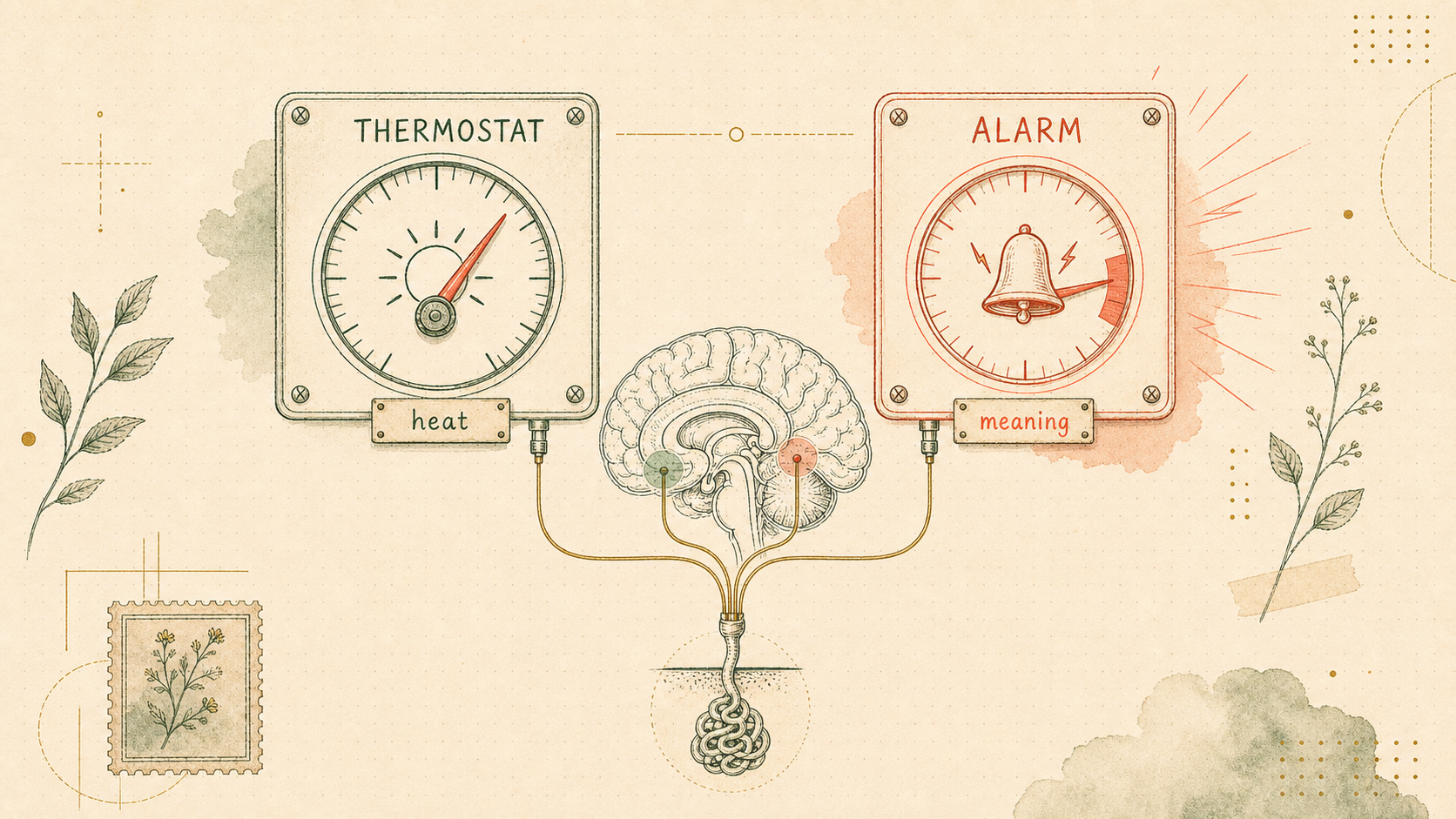
Why two routes? Because they answer to two different parts of the brain.
Heat sweat is managed mostly by the hypothalamus, your internal thermostat. It watches your core temperature and switches on cooling when you cross a line.2 Logical, measured, and tied to a number.
Stress sweat is managed by the limbic system, the amygdala and its neighbors, the part of the brain that handles emotion and reads a situation for threat. It is not checking a thermometer. It is checking what a moment means.2, 1
That is why stress sweat ignores the weather. The glands on your palms and soles are barely moved by heat at all; they answer to deep breaths, focus, and mental stress instead.2 So it can switch on in a cold room, in an air-conditioned office, in the back of a quiet car, because it was never about temperature. It was about the moment.
Sweaty palms are an ancient upgrade, not a glitch
Here is the part that turns embarrassment into something closer to awe. The reason a tense moment goes straight for your hands is that, long before there were job interviews, sweat there was useful.
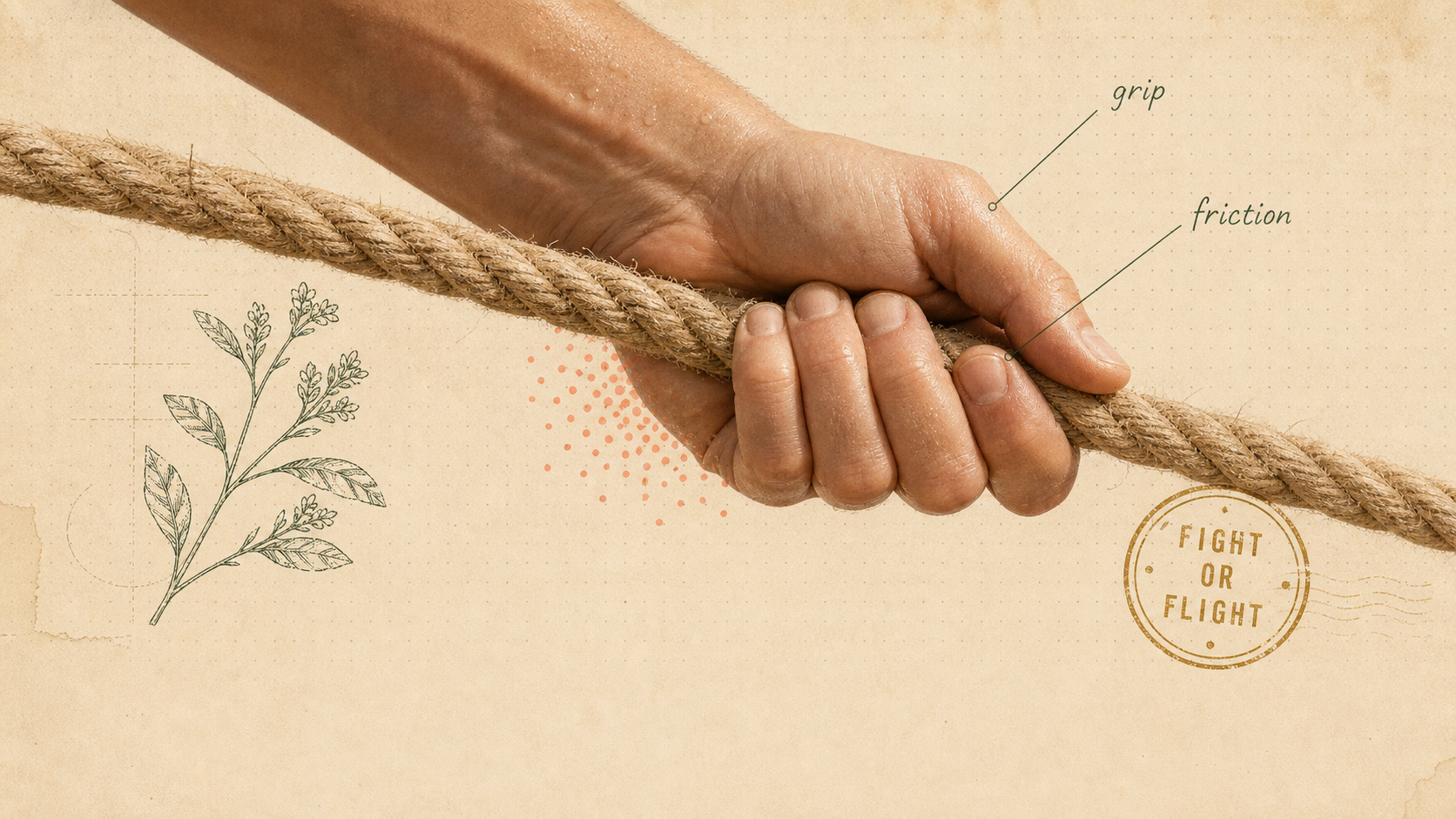
A faint film of moisture on the palms and fingertips increases friction. It helps you hold on, to a branch, a tool, a rope, and grip with precision when it counts. Researchers describe palm and sole sweating as acting to prevent slippage while grasping or doing fine work with the fingertips.2
So when your brain flags a high-stakes moment, it preps your hands the way it would for something physical: get ready to hold on, to climb, to act. The handshake is new. The wiring is very old. Your nervous system is not failing you. It is handing you grip you no longer strictly need, and being polite enough to do it anyway.
The one stop on the map that turns into odor
Of all the places stress sweat visits, most just leave you damp. Palms and soles get clammy and then dry off. The underarm is the exception, and it is the only stop people tend to worry about smelling.
That is not because underarm sweat is dirtier. It is the neighborhood. The underarm is warm, folded, low on airflow, and home to apocrine glands that release a richer, protein- and lipid-rich fluid when stress hits.4, 1 That fluid is odorless when it is fresh, but it is a better meal for the skin's resident microbes, which turn it into the smell over time. Notably, this is also the one form of stress sweat that does not really show up until puberty.1
So the map has exactly one stop you might actually want to do something about. The good news is that it is the easiest one to reach.
The calm move is one rinse
You cannot talk your amygdala out of a meeting, and you would not want to switch off a system that is trying to help you. Sweating is your body doing its job. What you can do is reset the single spot on the map that turns into odor.
That means washing the underarm rather than covering it. Odor forms on the skin over time, so cleaning the area resets the clock. GoodSweat is a shower deodorant made for exactly that: squeeze on, massage in, rinse clean, then get dressed without the sticky swipe.
It will not stop you from sweating, and it is not trying to calm your nerves. It just takes the one stop on the map that matters and gives it a clean start. Your stress sweat was never a flaw in the wiring. It is a very old map, doing exactly what it was drawn to do.
Sources
- Harker M. "Psychological sweating: a systematic review focused on aetiology and cutaneous response." Skin Pharmacology and Physiology, 2013;26(2):92-100. Source for psychological sweating being most evident on the palms, soles, face, and underarm, the limbic-versus-hypothalamic control split, and axillary sweat turning to malodour only after puberty.
- Asahina M, Poudel A, Hirano S. "Sweating on the palm and sole: physiological and clinical relevance." Clinical Autonomic Research, 2015;25(3):153-159. Source for palm and sole sweating being driven by mental stress rather than heat, the role of the limbic system, and the grip and anti-slip function of emotional sweating.
- International Hyperhidrosis Society. "Physiology of Normal Sweating." Public reference for the order of thermoregulatory sweating, which tends to begin at the scalp and forehead and spread down, with the palms and soles among the last regions to sweat from heat.
- Mayo Clinic. "Sweating and body odor." Public medical reference for apocrine glands responding to stress and adrenaline, and for how underarm odor forms on the skin over time.